APC Smart-UPS C SMC1000IC 1000VA LCD Pure Sine Wave UPS in Kenya | City Gadgets Kenya
Same-day delivery in Nairobi by 10 Oct – 11 Oct
Description
Buy the genuine APC Smart-UPS C SMC1000IC 1000VA 600W line interactive UPS with pure sine wave output, LCD display, 8 outlets and hot-swappable battery in Kenya from City Gadgets Kenya. APC 1KVA SMC UPS price in Kenya, UPS for POS, network and server equipment Nairobi.
APC Smart-UPS C SMC1000IC 1000VA LCD Pure Sine Wave UPS in Kenya
Genuine APC by Schneider Electric | Brand New | 1000VA / 600W Line Interactive | Pure Sine Wave Output | LCD Display | 8 Battery Backup Outlets | Hot-Swappable Battery | USB and Serial
Searching for the APC 1KVA SMC UPS price in Kenya, a pure sine wave UPS in Nairobi, or a more serious UPS for your point-of-sale, network gear or small server? The APC Smart-UPS C SMC1000IC is a brand-new, genuine 1000VA / 600W line interactive UPS from APC by Schneider Electric. Unlike budget UPS units, it produces a pure sine wave on battery, has an LCD display showing live load and battery information, eight battery-backed outlets and a hot-swappable battery, and APC lists a wide input range that copes with unstable mains. It's available from City Gadgets Kenya with delivery across Kenya. Buyers also search for it as an APC SMC1000IC, an APC Smart-UPS C 1000VA, an APC 1KVA UPS, a pure sine wave UPS, an APC UPS with LCD, a UPS for a small server, a UPS for network equipment or a UPS for POS and medical equipment.
This guide is written to help you decide whether a premium UPS is worth it for you. We explain what the SMC1000IC does better than a budget UPS, how long it runs, what the specifications really mean, and when a cheaper UPS is the smarter buy. If you'd like to talk it through, message us on WhatsApp.
The short verdict
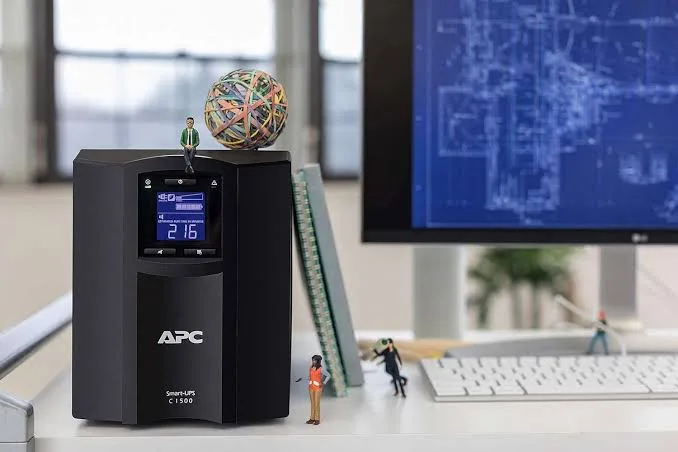
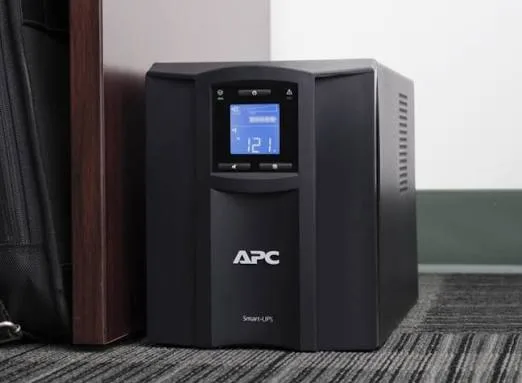
The APC Smart-UPS C SMC1000IC is a step up in quality and protection from the budget 1000VA UPS units. Its headline features are a true sine wave output on battery, which suits modern computers with active power-factor-corrected power supplies and sensitive equipment, and a wide input voltage range, 180 to 286 volts for normal operation and adjustable from 170 to 300 volts, which means it corrects mains swings without touching the battery. A graphic LCD shows input and output voltage, load, battery status and estimated runtime. The hot-swappable battery, a single APC RBC142 cartridge, can be replaced without switching the UPS off. APC's published runtime is about 14 to 16 minutes at half load (300 watts) and about 5 to 6 minutes at the full 600 watts. It costs considerably more than a Mecer or Mercury 1000VA, and for a plain desktop and router, those are enough. For servers, POS systems, network gear, medical or lab equipment and anything that must not fail, the extra is worth it.
Who this UPS is for
It suits you if:
- You protect a small server, a NAS, network switches and a firewall.
- You run a POS system, a pharmacy, a clinic or a lab, where equipment is sensitive and uptime matters.
- Your computers have active PFC power supplies, which can misbehave on a simulated sine wave.
- You want a display that shows load, runtime and faults.
- You want an easy battery swap without downtime.
- You want a trusted brand with a recognised warranty and long-term spares.
Look elsewhere if:
- You only protect a desktop and a router. See the Mecer 650VA, 850VA or 1000VA in our range, which cost much less.
- You need hours of backup. Ask us about larger battery packs and inverter systems.
- You need a rack-mount UPS. See the APC SMC1000I-2UC in our range.
- You need more than 600 watts. See the APC 1500VA, 2000VA and 3000VA models.
Specifications in plain English
| Feature | Detail | What it means for you |
|---|---|---|
| Model | APC Smart-UPS C SMC1000IC | APC's 1000VA tower UPS with LCD |
| Capacity | 1000VA / 600 W | The most real power it can supply |
| Topology | Line interactive | Corrects voltage without using the battery |
| Output on battery | Pure sine wave, with distortion under 5% at full load | Safe for sensitive and active-PFC equipment |
| Nominal voltage | 230 V, 50/60 Hz, with auto sensing | Matches Kenyan mains |
| Input range for normal operation | 180 to 286 V, adjustable 170 to 300 V | Handles big swings without the battery |
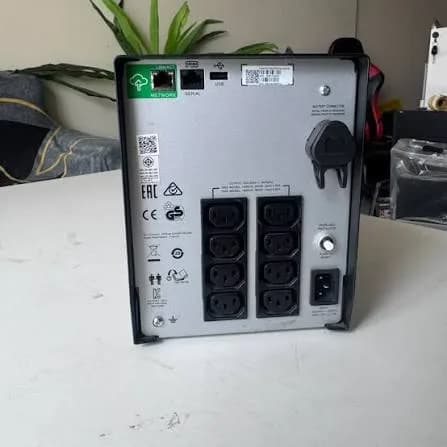
| Outlets | 8 x IEC C13 battery backup, plus 2 IEC jumpers | Many devices, plus daisy-chain options |
| Input connection | IEC C14 or C20, depending on version | Needs the matching power cord |
| Display | LCD with LED status indicators | Live information |
| Interface | USB and serial (RJ45) | Monitoring and shutdown software |
| Battery | Sealed lead-acid, APC replacement cartridge RBC142 (about 216 Wh) | Decides runtime, and is hot-swappable |
| Recharge time | About 3 hours | Ready again quickly |
| Runtime (APC and retailer figures) | About 14 to 16 minutes at half load, about 5 to 6 minutes at full load | A short window |
| Filtering | Full-time multi-pole noise filtering | Cleaner power |
| Size and weight | About 219 x 171 x 439 mm, about 17.3 kg | A compact tower, but heavy |
| Warranty | A two-year warranty is shown on some APC listings | Ask us what applies |
These figures come from APC data and retailer listings of the SMC1000IC. Some listings describe the closely related SMC1000I with a different input connector. Ask us to confirm the exact version, the warranty and what's in the box for the unit you order.
Why pure sine wave matters
This is the most important difference from a budget UPS.
- The mains waveform is a smooth sine wave. A budget UPS on battery produces a stepped approximation, called a simulated or modified sine wave.
- A pure sine wave UPS reproduces the smooth wave, just like the mains.
- Modern power supplies with active power factor correction (PFC), found in many desktops, servers and workstations, can shut down, buzz or overheat on a simulated sine wave. Server makers recommend pure sine wave UPS units for these.
- Motor-driven and sensitive equipment such as some medical devices, lab instruments, audio gear and certain pumps also prefer pure sine wave.
- Routers, modems and basic PCs usually work on either.
- A pure sine wave UPS costs more, and it's cheap insurance for equipment that matters.
If your equipment's manual says "pure sine wave UPS recommended", the SMC1000IC is a good fit.
The wide input range: why it helps in Kenya
APC lists 180 to 286 volts for normal operation, and an adjustable range of 170 to 300 volts.
- Mains in Kenya can sag or surge. A weak supply might sit at 190 volts, and a surge might hit 250 or more.
- AVR corrects within the range without switching to the battery. APC describes the Smart-UPS C family as boosting low input up to about 30 percent and trimming high input up to about 12 percent.
- That saves the battery for real outages, so it lasts longer and is ready when you need it.
- Adjustable sensitivity lets you widen or narrow the range, if your equipment tolerates it.
For an area with frequent voltage swings, this feature alone justifies the premium.
How long will it really run?
APC and retailers publish runtime figures, and they're a realistic guide.
| Load on the UPS | Approximate backup time |
|---|---|
| 300 watts (half load) | About 14 to 16 minutes |
| 600 watts (full load) | About 5 to 6 minutes |
What this means in practice:
- A POS counter or small desktop setup drawing about 150 to 250 watts might run for roughly 15 to 25 minutes.
- A small server and a switch drawing about 150 watts might run for roughly 25 to 30 minutes.
- Network gear alone, such as a router, a switch and a firewall at about 50 watts, might run for well over an hour.
- Runtime falls quickly as load rises, because the battery is a single cartridge.
- Batteries age, so test and replace on schedule.
APC also provides an online runtime calculator, and we can run your load through it with you.
The LCD display: what it tells you
The LCD is a practical feature that budget units lack.
- Input and output voltage, so you can see mains quality.
- Load percentage, so you know how close you are to the limit.
- Battery status and charge.
- Estimated runtime on battery for your load.
- Faults and alarms, in words and symbols.
- Configuration menus, for voltage sensitivity, alarms and outlet behaviour.
Reading the display tells you at a glance whether your UPS is healthy, which helps with fault-finding and planning.
Outlets and jumpers
The SMC1000IC's outlets are designed for IT equipment.
- Eight IEC C13 outlets with battery backup and surge protection.
- Two IEC jumper outlets for daisy-chaining equipment or connecting another UPS in a combination, as the manual describes.
- C13 outlets need IEC power cords. Most computers and servers use them, and many devices need a cord adapted to a UK three-pin plug at the other end. Check what you need, or ask us.
- UK three-pin devices such as routers with plug-in adapters need a C13-to-UK-socket lead.
- Don't overload a single outlet. Spread the load.
Sizing: how to work out what you need
- List what you'll plug in.
- Find each device's power in watts, on its label or specifications.
- Add the watts together.
- Keep the total below about 60 to 70 percent of 600 watts, which is about 360 to 420 watts.
- Remember that VA is not watts. A 1000VA UPS supplies 600 watts.
- Add a margin for growth.
- Choose the next size up if you're close. See the 1500VA and larger Smart-UPS C models.
What you can and can't plug in
Good to plug in
- A small server, a NAS and network switches.
- A POS computer, monitor, scanner and card machine.
- A router, firewall and Wi-Fi controller.
- A CCTV recorder and cameras.
- Lab and clinic equipment that the maker allows on a UPS.
Don't plug in
- Laser printers, which draw a big surge when they warm up.
- Heaters, kettles, irons, microwaves and hair dryers.
- Fridges, freezers and air conditioners.
- Power tools and pumps.
Setting up the UPS
- Choose a spot with good ventilation, off the floor and away from damp, direct sun and heat.
- Connect the battery following the manual, if it's disconnected for shipping.
- Charge it for at least 3 to 8 hours before first use.
- Plug the UPS into a wall socket with a good earth, using the right power cord.
- Plug your equipment into the battery backup outlets.
- Connect the USB cable to your server or computer, and install APC's PowerChute software for automatic shutdown.
- Set the LCD options, such as alarms and voltage sensitivity.
- Test it: with equipment on, unplug the UPS from the wall for a few seconds, and check that equipment keeps running and the alarm sounds.
- Record the install date and plan the battery replacement.
Looking after the battery
- Expect a life of about 3 to 5 years, depending on heat and use.
- Keep the UPS cool, because heat shortens battery life more than anything else.
- Use APC's automatic battery tests and the LCD's replacement indicator.
- Replace the battery with a genuine RBC142 cartridge, which is hot-swappable.
- Test it every few months with a pull-the-plug test.
- Keep a spare battery for important sites.
Is a premium UPS worth it? A plain-language test
It's a fair question, since the APC costs several times what a budget 1000VA does. A short test helps.
It's worth it if you answer yes to any of these:
- Does the equipment's manual recommend a pure sine wave UPS?
- Would an hour of downtime cost you more than the price difference?
- Do you run a server, a NAS or a database where a bad shutdown could corrupt data?
- Do you run medical, lab or audio equipment sensitive to power quality?
- Do you need to see load and runtime on a display, to manage a site?
- Do you want to swap the battery without switching off?
A budget UPS is enough if:
- You protect one desktop and a router.
- The equipment is cheap to replace, and doesn't hold critical data.
- You mainly need a few minutes to save and shut down.
We'll tell you honestly which side you're on.
A worked example: a small clinic or pharmacy
A clinic's equipment is a good case for the SMC1000IC.
- List the equipment: a reception computer (about 80 watts), a monitor (25 watts), a label or receipt printer (about 10 watts average), a barcode scanner (3 watts), a router (15 watts) and a small network switch (10 watts). The total is about 145 watts.
- Check the rating. 145 watts is under a quarter of 600 watts, so the UPS is very comfortable.
- Estimate the runtime. With APC's half-load figure of about 14 to 16 minutes at 300 watts, a 145-watt load should run for well over 20 minutes, which is time to finish a transaction and shut down. The real figure depends on the battery's age.
- Add data protection. Install PowerChute so the computer shuts down by itself if nobody's there.
- Keep the vaccine fridge and any lab equipment on their own protection. A fridge isn't a UPS load, and medical devices need advice from their makers.
- Test monthly, and note the date.
Using PowerChute and automatic shutdown
APC supplies software to manage the UPS.
- Install PowerChute on the computer connected by USB or serial.
- Set the shutdown rules: how many minutes on battery before the computer shuts down safely.
- Set alerts: by email or on-screen, so you know about cuts and faults.
- Use it for several computers, if your version supports a network or a network management card. Ask us.
- Test the shutdown on a quiet day.
- Keep the software updated.
Automatic shutdown protects data when nobody's around, such as at night or a weekend.
Pure sine wave, active PFC and your computer
A technical point worth understanding.
- Active PFC power supplies improve efficiency by shaping the current they draw. They're common in modern desktops, workstations and servers.
- On a simulated sine wave, some of these power supplies behave badly, shutting down when the UPS switches to battery.
- A pure sine wave UPS avoids the problem.
- If your computer shuts down on a budget UPS, this is the likely cause, and a pure sine wave UPS such as the SMC1000IC is the cure.
- Ask us if you're not sure what power supply your computer has.
Common problems and simple fixes
The UPS beeps constantly on mains power. Check the load on the LCD. It may be overloaded, or the battery needs replacing.
It switches to battery often. Mains voltage may be outside the input range. Check the LCD, and consider adjusting the sensitivity, if your equipment allows.
It doesn't power on. Check the wall socket, the cord and the battery connection. The battery may need charging.
Runtime is shorter than expected. The battery has aged, or the load is higher than you think. Check the LCD.
The LCD shows "replace battery". Replace the RBC142, which is hot-swappable.
The computer doesn't shut down automatically. Install PowerChute, and check the USB cable.
The UPS is hot or smells. Switch it off and unplug it. Ask us, and don't use it until it's checked.
If a problem continues, message us on WhatsApp.
Questions to ask before you buy any UPS
- What equipment will it protect, and how many watts does it draw?
- How long do I need it to run?
- Does my equipment need pure sine wave?
- What input range does it handle?
- What battery does it use, and can I hot-swap it?
- What warranty is included, on the UPS and the battery? Get it in writing.
- Can I see it, and test it, before I pay?
We're glad to answer all of these on WhatsApp or in the shop before you pay.
Looking after the UPS for years
- Keep it cool, dry and ventilated.
- Test it every few months.
- Don't overload it.
- Replace the battery on time.
- Use an earthed socket.
- Keep the manual, box and receipt.
- Keep the software updated.
Warranty and after-sales: what to ask
A UPS has two parts that matter: the unit and the battery. Ask us what warranty covers the unit you order, how long it lasts, and whether the battery has a separate, shorter warranty. Some APC listings show two years, and Kenyan terms may differ. Keep your receipt, the serial number and the box. If a fault appears, message us on WhatsApp first, and we'll tell you the quickest way to get it sorted.
Using a UPS in Kenya
Power quality. Voltage swings are common, and the wide input range and AVR are valuable.
Heat. Don't put the UPS in a closed cupboard or direct sun.
Earthing. Use a properly earthed socket.
Weight. The SMC1000IC weighs about 17 kg, so lift it with care and place it on a strong surface.
Theft. Keep it secured.
Warranty. Ask us for the warranty that applies to the unit you order, including the battery. Keep the receipt and box.
How it compares with other options in our range
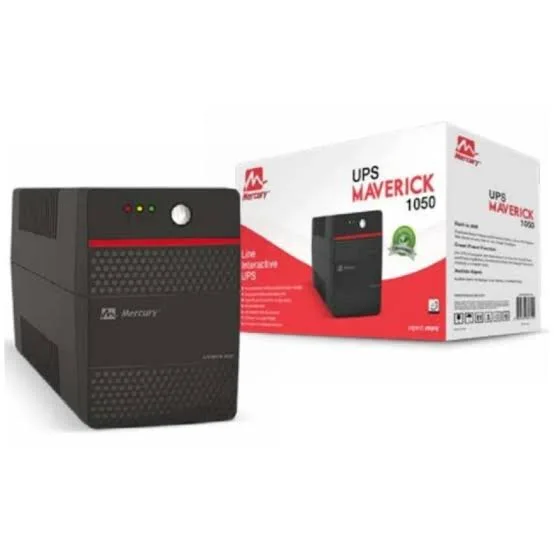
| APC SMC1000IC | Mecer 1000VA | Mercury 1050 | APC SMC1000I-2UC (rack) | |
|---|---|---|---|---|
| Capacity | 1000VA / 600 W | 1000VA / about 600 W | 1050VA / about 630 W | 1000VA / 600 W |
| Output on battery | Pure sine wave | Simulated sine wave | Simulated sine wave | Pure sine wave |
| Display | LCD | LED or basic | Confirm | LCD |
| Hot-swap battery | Yes | No | No | Yes |
| Best for | Servers, POS, sensitive gear | Desktops and CCTV | Desktops and POS | Racks and cabinets |
Against the Mecer and Mercury 1000VA models: they cost much less, have a simulated sine wave and a basic display. The APC suits equipment that deserves better.
Against the APC rack model: the same power in a rack-mount case.
Honest pros and cons
Pros
- Pure sine wave output.
- A wide input range, with AVR.
- An LCD showing load, voltage and runtime.
- A hot-swappable battery.
- Eight battery backup outlets and two jumpers.
- USB and serial monitoring.
- A trusted brand.
Cons
- A much higher price than budget 1000VA units.
- Short runtime at high loads, with one battery cartridge.
- Heavy for its size.
- C13 outlets need IEC cords for some devices.
- Not for printers or heavy appliances.
What to check when it arrives
- The box model matches APC SMC1000IC.
- The UPS, power cords, USB cable, software and paperwork are in the box.
- The battery is connected, and charges.
- The LCD works, and shows voltage and load.
- A pull-the-plug test works, and the alarm sounds.
- You get a receipt with the serial number and warranty details in writing.
Frequently asked questions
What is the APC SMC1000IC price in Kenya? We confirm the current price when you message us on WhatsApp, because supplier prices change. We tell you the price and what's in the box before you pay.
Where can I buy the APC Smart-UPS C 1000VA in Nairobi? At City Gadgets Kenya, New Alnoor Exhibition, Second Floor, Shop C7, Accra Road, Nairobi CBD, or by delivery.
Is it pure sine wave? Yes, on battery.
How long will it run? About 14 to 16 minutes at half load, and about 5 to 6 minutes at full load.
Can I replace the battery myself? Yes. The battery is hot-swappable. Use a genuine RBC142.
Does it have a display? Yes, an LCD.
Can I plug in a printer? No. Use a surge protector for printers.
What warranty does it have? Ask us for the warranty that applies to the unit you order.
Can you deliver it? Yes, same day in Nairobi and next day outside Nairobi.
Can I pay via M-Pesa? Yes.
Why buy from City Gadgets Kenya
Genuine, brand-new APC UPS. We're at New Alnoor Exhibition, Second Floor, Shop C7, Accra Road, Nairobi CBD, and you're welcome to talk to us about your equipment before you buy. Message us on WhatsApp with the devices you want to protect, and we'll tell you honestly whether the Smart-UPS C is worth it or a cheaper UPS will do. We confirm what's in the box before you pay.
Order your APC Smart-UPS C SMC1000IC today
Available now at City Gadgets Kenya. Message us on WhatsApp.
Specifications
- Brand
- APC
- Condition
- New
Frequently Asked Questions
How much does the APC Smart-UPS C SMC1000IC 1000VA LCD Pure Sine Wave UPS in Kenya | City Gadgets Kenya cost in Kenya?
The APC Smart-UPS C SMC1000IC 1000VA LCD Pure Sine Wave UPS in Kenya | City Gadgets Kenya is priced at Ksh 74,000 at City Gadgets. You can pay via M-Pesa, card or cash on delivery.
Is the APC Smart-UPS C SMC1000IC 1000VA LCD Pure Sine Wave UPS in Kenya | City Gadgets Kenya available in Kenya?
Yes — the APC Smart-UPS C SMC1000IC 1000VA LCD Pure Sine Wave UPS in Kenya | City Gadgets Kenya is in stock at City Gadgets, ready for same-day delivery in Nairobi and countrywide shipping across Kenya.
Is the APC Smart-UPS C SMC1000IC 1000VA LCD Pure Sine Wave UPS in Kenya | City Gadgets Kenya genuine and does it have a warranty?
Every APC Smart-UPS C SMC1000IC 1000VA LCD Pure Sine Wave UPS in Kenya | City Gadgets Kenya we sell is 100% genuine brand-new stock and comes with a 12-month official brand warranty.
Do you deliver the APC Smart-UPS C SMC1000IC 1000VA LCD Pure Sine Wave UPS in Kenya | City Gadgets Kenya in Nairobi?
Yes. We offer fast same-day delivery within Nairobi and fast, affordable delivery to the rest of Kenya — order online or on WhatsApp.
Customer Reviews
No reviews yet
Be the first to review this product.
Rate us on Google
Your review helps other shoppers find us
Reviews from verified buyers will appear here.