A speaker box says "55,000 W". Another says "1,000 W". A third says "200 W". Which is loudest? If you answered "the 55,000 W one", you have just fallen for the oldest trick in audio marketing. Power ratings on speakers are among the most abused numbers in consumer electronics, and understanding them can save you real money and disappointment. This guide explains RMS vs PMPO speaker watts and everything around them: what a watt measures, why continuous (RMS) power is the honest figure, what peak and PMPO claims mean, how sensitivity and decibels decide actual loudness, why doubling the watts barely changes how loud something sounds, how to read the specifications of soundbars, home theatre systems, party speakers and Bluetooth speakers, and how to spot inflated claims. We use real products from our range as examples: the Nobel multimedia speaker systems, the Logitech Z906, the Sony and Hisense soundbars, and Anker Soundcore portable and party speakers.
The short version
- RMS (continuous) power is how much power an amplifier or speaker can handle steadily. It is the most honest, comparable figure.
- Peak power is the maximum for a brief moment (milliseconds). It is higher than RMS, often about two to four times.
- PMPO (Peak Music Power Output) has no standard. It is a marketing number that can be tens or hundreds of times the true continuous power.
- Loudness is not proportional to watts. Doubling the power adds only about 3 decibels, which is barely noticeable. You need roughly ten times the power to sound twice as loud.
- Sensitivity, speaker design, room and distortion matter as much as watts.
- A speaker claiming "55,000 W" but delivering about 200 W RMS is a typical example of how headline numbers inflate.
What is a watt?
A watt measures the rate of energy transfer. In audio, it tells you how much electrical power an amplifier delivers to a speaker, or a speaker can safely accept. More power lets an amplifier drive the speaker to higher volume without distortion, especially on loud peaks in music and films. But the relationship between watts and loudness is not simple, as we will see.
RMS: the honest number
RMS stands for "root mean square", a mathematical way of describing the effective value of a changing signal. For power ratings, RMS means the continuous power an amplifier can deliver (or a speaker can handle) over a sustained period without damage or excessive distortion. It is measured with a steady test tone, typically at a stated distortion level (for example, "at less than 1% total harmonic distortion") and into a stated impedance (for example, 4 or 8 ohms).
A good RMS rating includes the conditions: the impedance, the frequency range and the distortion level. A bare "100 W RMS" with none of these is less informative than "2 x 50 W RMS into 4 ohms at 1% THD, 20 Hz to 20 kHz".
RMS ratings let you compare products fairly, because they use the same basic idea. A soundbar of 100 W RMS is, for most practical purposes, about twice as capable as one of 50 W RMS (though twice the power is not twice as loud).
Peak power
Music and film are not steady tones. They have short, sharp peaks: a drum hit, an explosion, a gunshot. An amplifier needs headroom to reproduce peaks cleanly. Peak power measures the maximum an amplifier can deliver for a very short time, usually milliseconds. It is typically higher than RMS by a factor of about two for many designs, and sometimes more.
Peak ratings are not dishonest by themselves; they describe a real property. They become misleading when presented as the headline number without the RMS figure, because a buyer assumes the peak is the usual power.
Music power and "music power output"
Some manufacturers specify "music power" or "dynamic power", measured with a short burst of tone or music-like signals. It sits between RMS and peak. It is a legitimate older standard in some regions, but loosely defined. Use it only as a rough indicator.
PMPO: the number to ignore
PMPO (Peak Music Power Output or Peak Maximum Power Output) is the notorious one. It has no accepted international standard. Manufacturers can define it however they like, for instance by measuring the instantaneous power an amplifier can briefly produce under ideal conditions, or by adding up the theoretical limits of components. Typical PMPO figures are 10 to 100 times the true RMS rating, and sometimes more.
Examples from the market:
| Product type | Typical PMPO claim | Typical real RMS |
|---|---|---|
| Small multimedia 2.1 speakers | 5,000-20,000 W PMPO | 10-40 W RMS |
| Mid-size multimedia 2.1 or 3.1 | 20,000-55,000 W PMPO | 50-220 W RMS |
| Large multimedia tall-boy systems | 50,000+ W PMPO | 150-300 W RMS |
Our own product pages state this plainly. The Nobel NB2070 3.1 tall-boy system is listed with 55,000 W PMPO, "a peak marketing figure," while one retailer lists about 200 to 220 W RMS. The Nobel NB1211 lists 22,000 W PMPO, also a peak marketing figure. 55,000 W PMPO versus about 200 W RMS is a ratio of roughly 250 to 1, which shows why you can't read PMPO as real power. Such systems can still sound big and bassy and be great for parties and general entertainment; the point is simply that the number on the box says nothing about how loud they are.
Why watts and loudness are not the same thing
The decibel scale
Loudness is measured in decibels (dB), a logarithmic scale. Every 3 dB increase corresponds to roughly a doubling of power, but a 3 dB change is only just noticeable. To make a sound seem about twice as loud to human ears, you need an increase of about 10 dB, which needs about ten times the power.
| Power change | Change in level | How it sounds |
|---|---|---|
| Double the power (e.g. 50 W to 100 W) | About +3 dB | Slightly louder, barely noticeable |
| Four times the power (50 W to 200 W) | About +6 dB | Clearly louder |
| Ten times the power (50 W to 500 W) | About +10 dB | Roughly twice as loud |
| 100 times the power (50 W to 5,000 W) | About +20 dB | Four times as loud |
This is why upgrading from a 100 W system to a 200 W system is usually a modest improvement in maximum volume, not a doubling. It also means that a claim of "1,000 W" over "500 W" is much less impressive than it sounds.
Sensitivity
Sensitivity measures how efficiently a speaker turns power into sound, usually given in dB at 1 metre for 1 watt. A speaker with 90 dB sensitivity is louder, for the same watts, than one with 84 dB. A 6 dB difference in sensitivity is equivalent to four times the power. So a sensitive speaker driven by a small amplifier can outperform an insensitive one driven by a big amplifier. Big, efficient speakers are the secret of loud, clean sound; tiny speakers with big claims are limited by physics.
Driver size and cabinet
A small driver cannot move much air, no matter how much power you give it. To produce deep bass at high volume you need either large drivers or a lot of cone excursion, which small speakers cannot sustain without distortion. This is why a modest set of large speakers can sound more powerful than a tiny speaker with an enormous watt rating.
Impedance
Speakers are rated at an impedance in ohms (commonly 4 or 8). A lower-impedance speaker draws more current, so the same amplifier delivers more power into 4 ohms than into 8, up to its limits. Rated power is quoted at a stated impedance. Ratings without impedance information are incomplete.
Distortion
An amplifier can "make" a lot of power if you accept a lot of distortion. Power ratings should be quoted at a low distortion level, such as 1% THD or lower. A rating at 10% THD is a way of squeezing out a bigger number that you will not enjoy listening to.
What's a sensible amount of power?
The real answer depends on room size, speakers and listening habits, but these ranges are reasonable for real RMS figures.
| Use | Reasonable continuous (RMS) power |
|---|---|
| Desktop speakers for one listener | 5-30 W total |
| Bedroom or small-room TV soundbar | 30-100 W total |
| Medium living room soundbar or system | 100-300 W total |
| Larger room or home cinema | 300-600 W total |
| Party or small-event speaker (portable) | 50-200 W (rated honestly) |
| Church or hall PA system | Professional PA gear, not home audio |
Most homes do not need more than 100-200 W RMS of true power. If you live in a flat with neighbours, you will rarely use even that.
How to read the power rating on real products
Manufacturers state power in different ways. Here is how to interpret what we see on the products in our range. These notes reflect manufacturer and retailer listings; ask us to confirm the details of the unit you order.
Soundbars (Sony and Hisense)
Soundbar makers usually quote total system output, adding up the front speakers, subwoofer and rear speakers. For example, the Sony HT-S60 is listed at 1,000 W total, with 152 W each for the front left, right and centre, 240 W for the subwoofer and 152 W for each rear speaker, per Sony. The Hisense AX5100Q is listed at 580 W maximum, the HS5100 at 540 W, the HS3100 at 480 W maximum and the HS1800 at 140 W maximum. The Sony HT-S400 is listed at 330 W, the HT-S20R at 400 W and the HT-S40R at 600 W.
Two cautions. First, "total" adds many channels together, so a 600 W five-channel system is not "600 W of loudness"; each speaker gets a fraction. Second, "maximum" suggests a peak or best-case figure, not continuous power. Where the maker does not specify, treat the number as indicative rather than precise. A good soundbar sounds good because of its design, not only its wattage.
Home theatre and PC speaker systems (Logitech Z906)
The Logitech Z906 is commonly described as a 1,000 W system, which is its peak power. Logitech's own continuous rating is commonly quoted as 500 W RMS across the system, with the subwoofer taking the largest share. That is a good example of an honest dual rating: a peak figure and an RMS figure, with the RMS being about half the peak. That ratio, 2 to 1, is typical of a serious manufacturer's peak-to-RMS relationship. Compare it with PMPO claims that are 100 times the RMS. We confirm the exact rating of the unit you order.
Multimedia speaker systems (Nobel)
Nobel's range lists very large PMPO figures. The NB2070 lists 55,000 W PMPO, the NB1211 lists 22,000 W PMPO, and one retailer puts the NB2070 at about 200 to 220 W RMS. The Nobel systems add useful extras: Bluetooth, USB, SD card playback, AUX, FM radio, an LED display and a remote control, and they can sound big and bassy at home. Judge them by their RMS and by listening, not by PMPO. Ask us for the RMS figure of the exact model before you buy.
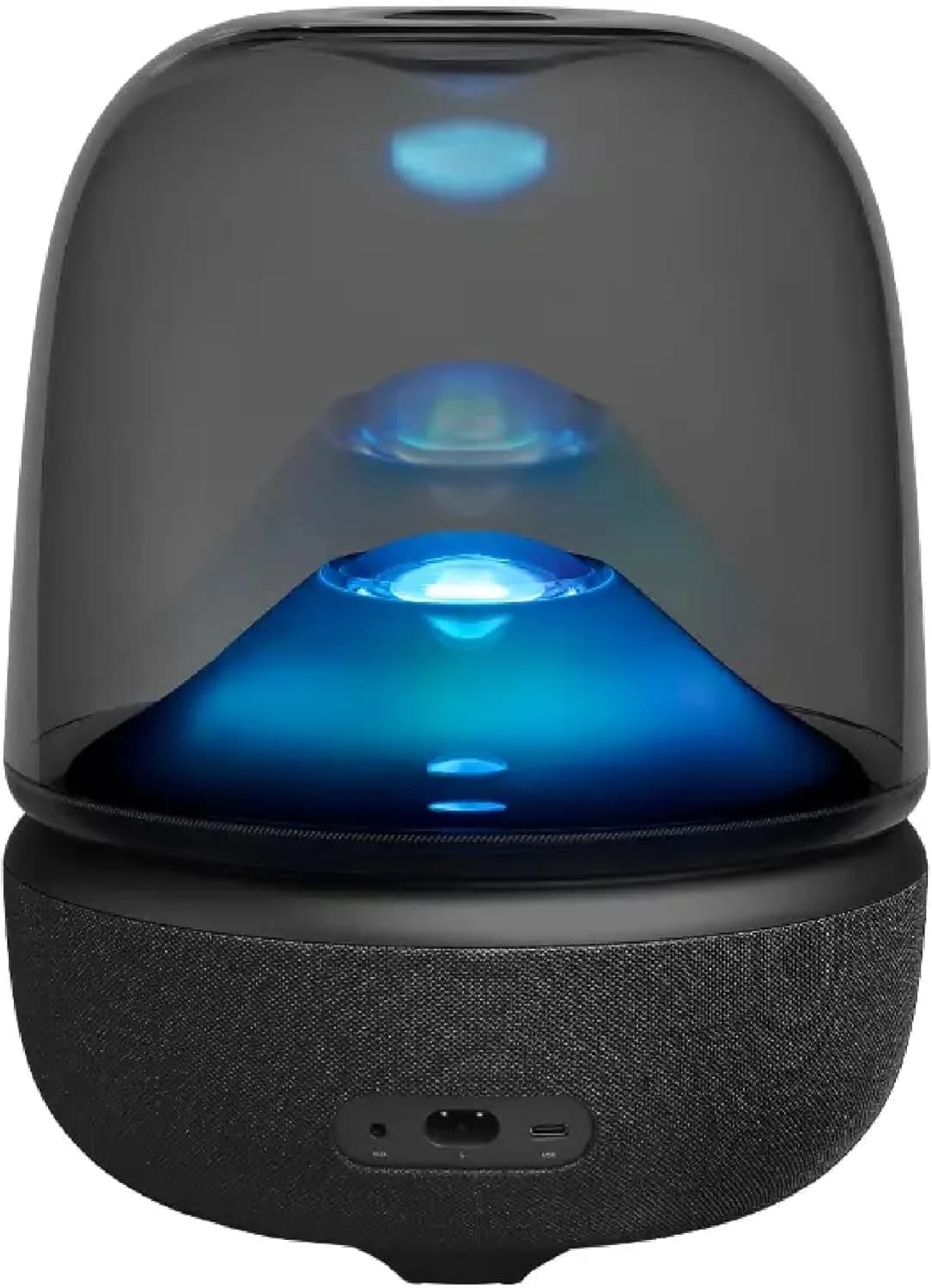
Portable and party speakers (Anker Soundcore)
The Soundcore Rave 3S party speaker is listed at 200 W, with two wireless microphones for karaoke, a light show and IPX4 splash resistance. The Boom 2 Plus is listed at 140 W with RGB lighting. Brands do not always say whether such figures are RMS or peak, so treat them as marketing indicators and rely on reviews and listening. For portable speakers, battery capacity, driver size and design influence the real loudness as much as the watt figure. The Soundcore Select 4 Go, a small IP67 shower-friendly speaker, shows the other end of the range: modest power, great portability.
JBL
The JBL 2.1 MK2 is a compact 2.1 system with a dedicated subwoofer. JBL's detachable-rear Bar 800 MK2 is a premium soundbar. Look at the product sheets for the maker's stated total power and whether it specifies RMS. Reputable brands generally publish RMS figures somewhere, even if the box shows a bigger number.
| Product | Listed power (per listings) | What kind of figure | Our interpretation |
|---|---|---|---|
| Sony HT-S60 | 1,000 W total | Total system output, with per-channel figures | Strong system, real surround |
| Hisense AX5100Q | 580 W max | Maximum | Capable 5.1 Atmos system |
| Hisense HS3100 | 480 W max | Maximum | Good 3.1 for medium rooms |
| Hisense HS1800 | 140 W max | Maximum | Entry-level 2.1 for small rooms |
| Logitech Z906 | 1,000 W peak (commonly 500 W RMS) | Peak and RMS | Powerful 5.1 for large rooms |
| Nobel NB2070 | 55,000 W PMPO (one retailer: about 200-220 W RMS) | PMPO | Loud and bassy, use RMS to compare |
| Soundcore Rave 3S | 200 W | Unspecified | Party speaker with karaoke |
| Soundcore Boom 2 Plus | 140 W | Unspecified | Outdoor portable speaker |
Why a "weaker" speaker can sound louder
Imagine two speakers. Speaker A has 100 W RMS and a sensitivity of 84 dB. Speaker B has 50 W RMS and a sensitivity of 90 dB. At full power, Speaker A produces about 84 + 20 = 104 dB (ignoring room effects), while Speaker B produces about 90 + 17 = 107 dB (20 log10 of the square root of power ratio; simply, 10 log10(50) is 17 dB). Speaker B, with half the watts, is louder. This is why professionals look at sensitivity and maximum SPL (sound pressure level) as well as watts.
You rarely see sensitivity on consumer boxes, but you can often find a "maximum SPL" figure or read reviews measuring real output. For party and event speakers, maximum SPL is a better guide than watts.
Power and Bluetooth speakers: battery matters
A portable speaker draws its power from a small battery, which limits how much it can deliver. A 200 W claim on a battery-powered speaker should make you ask how the battery could supply it. In practice, portable speakers reach their peak output for brief moments and run at far lower average power. When they play loudly, battery life falls quickly: a speaker rated for 15 hours at moderate volume might last only a few hours at maximum. Use the speaker at 60-70% of maximum for the best combination of clean sound and long battery life, and plug in for events. See our guide to the best Bluetooth and party speakers.
Power in the real world of Kenyan homes and events
Flats and neighbours. A 100 W system in a typical flat is already louder than you can use at night. Choose a bar with a night mode and keep bass under control. Bass is the sound that travels through walls.
House parties and weddings at home. Multimedia speakers like the Nobel tall-boy systems and Soundcore party speakers can fill a compound. For larger events, hire proper PA equipment rather than stretching a home system, which may overheat, distort or fail.
Churches and schools. A hall of fifty or more people needs a PA system with an amplifier and speakers designed for sustained speech and music. Home soundbars are not designed for it.
Shops and restaurants. Background music at moderate volume is easily handled by a modest system. A powered Bluetooth speaker or a compact 2.1 system is usually adequate.
Outdoor use. Open air swallows sound; you need far more power to achieve the same loudness as indoors. Battery speakers with large drivers and good efficiency perform best.
Power supply. Large systems draw power. An unstable supply damages amplifiers. Use a surge-protected socket or a UPS for important systems. See our blog on power surges and AVR.
Amplifier classes and why they matter less than you think
Amplifier "classes" (A, AB, D) describe how the circuit works. Class D amplifiers, used in nearly all modern soundbars and portable speakers, are highly efficient, run cool and are compact. Class AB amplifiers, found in some traditional hi-fi and powered speakers, can offer very smooth sound at the cost of heat and size. For a shopper, class matters much less than the overall design and tuning. Good class D amplifiers sound excellent, and poor class AB amplifiers do not. Do not buy on class alone.
Testing loudness yourself
You can sidestep the claims by listening.
- Use the same track on every system, at the same distance.
- Start at a normal level and increase gradually. Note the point where distortion begins: rattling, harshness, bass that turns to mud.
- Judge clean volume, not maximum volume. A speaker that stays clean at 80% beats one that screams at 100%.
- Test with speech and music. Dialogue clarity at high levels reveals weak designs.
- Test bass at moderate levels. Cheap systems exaggerate boom.
- Use a free decibel-meter app on your phone if you want numbers. They are not laboratory-accurate but are fine for comparison.
- Remember the room. A showroom is not your living room, so ask yourself how it will sound in your space.
Common power myths
"More watts always means louder." Not proportionally, and not without sensitivity and design.
"RMS is a worse number than peak." It is a better, more honest number.
"All brands measure watts the same way." They do not; always check what kind of figure it is.
"A big subwoofer watt number means deep bass." Bass depth depends on driver size, enclosure and tuning as well as amplifier power.
"Cheap speakers with huge watt claims are bargains." Often the opposite: the claim is the product.
"If it doesn't say RMS, it must be RMS." Assume it is not unless it says so.
"My system needs to be as powerful as possible." Beyond a sensible level, extra power costs more and delivers little audible benefit in a home.
Worked sizing examples: matching watts to a real space
Numbers are easier to trust when you see them applied. These examples assume honest RMS figures, which is the only kind worth planning around. If a speaker only advertises PMPO, treat the numbers below as a reason to ask for the RMS rating before you buy.
A bedsit or single room, about 3 by 4 metres. Listening is close, usually under two metres away. A Bluetooth speaker rated around 20 to 40 watts RMS fills this space with room to spare. Going bigger buys you nothing except a heavier bag and a shorter battery life. A compact 2.1 soundbar in the 100 to 140 watt class, such as the Hisense HS1800 (rated at 140 watts, 2.1 channel), is already generous for this room when it sits under a TV.
A living room, about 4 by 5 metres, with a 55-inch TV. Here you want dialogue clarity more than raw output. A 2.1 or 3.1 soundbar with a separate subwoofer works well. The Hisense HS3100 is a 3.1 model quoted at 480 watts, and the extra centre channel is what helps voices cut through film soundtracks. Whether that figure is a peak number or a sustained one is something we confirm for you in the shop; do not assume the largest figure on a box is the continuous one.
A large lounge, open plan, or a small shop. Distances grow, background noise grows, and one small speaker will struggle. Either step up to a bigger soundbar system such as the Sony HT-S60 (5.1 channel, quoted at 1000 watts, with eARC and Dolby Atmos/DTS:X support) or use two or more matched speakers rather than one very powerful unit. Two speakers spread across a room sound louder and cleaner than one speaker pushed to its limit in a corner.
A church, school hall or outdoor event. This is genuine PA territory. Home speakers are the wrong tool, because they are voiced for close listening and cannot sustain output for hours. Ask us about powered PA speakers and the right microphones, and be honest about the number of people and the size of the space so we can recommend something sensible rather than the biggest box on the shelf.
Impedance and wiring basics, in plain language
Watts do not exist in isolation. A speaker has an impedance, measured in ohms, and an amplifier is designed to drive a certain impedance. Most home speakers are 4 or 8 ohms. A lower impedance draws more current from the amplifier, which is why an amplifier rated at 100 watts into 8 ohms may deliver more into 4 ohms, and why a spec sheet that does not say which impedance it was measured at is incomplete.
For ordinary buyers this matters in three situations. First, if you are connecting passive speakers to an amplifier or AV receiver, check that the speaker impedance matches what the amplifier supports. Second, if you are wiring two speakers to one output, you are changing the load the amplifier sees, so read the manual first. Third, if a product claims a huge wattage with no impedance stated, the figure is almost certainly a marketing number rather than a measured one.
Powered speakers, soundbars and Bluetooth speakers have the amplifier built in and matched to the drivers by the manufacturer, so none of this is your problem. That is one more reason these are the easiest products for most households.
Quick glossary
- RMS (root mean square): a measure of continuous power the amplifier can deliver, the most honest comparison number.
- Peak power: the maximum the amplifier can deliver for a brief instant, often around twice the RMS figure or more.
- Music power: a short-duration rating used on some older products, higher than RMS but lower than PMPO.
- PMPO (peak music power output): a theoretical maximum with no agreed standard, which is why it can look enormous.
- Impedance: the electrical load of a speaker in ohms, which affects how much power an amplifier can deliver.
- Sensitivity: how loud a speaker gets for a given input, in decibels. Higher sensitivity means more volume from fewer watts.
- Headroom: spare power the system keeps in reserve so loud passages do not distort.
- THD (total harmonic distortion): a measure of how much the signal is altered at a given power, lower is better.
The bottom line on watts
Ignore the biggest number on the box. Look for RMS, check the number of channels and the subwoofer, think about the room, and compare like with like. A modest speaker with an honest rating will outperform a loudly advertised one in nearly every home. If you are not sure what a figure on a listing means, send us the model name on WhatsApp and we will tell you what it really is before you spend anything.
How to spot inflated power claims and fake speakers
- PMPO or no label. A huge number with no RMS beside it is a flag.
- Implausible numbers for the size. A pocket-sized speaker claiming hundreds of watts, or a light bar claiming thousands, cannot be honest.
- Check weight and heat sinks. Real power needs big transformers or efficient amplifiers with heat dissipation. Very light units rarely deliver high power.
- Check the power supply. A speaker claiming 200 W RMS with a tiny 12 V adapter does not add up. Compare the adapter's rating with the claim.
- Check the manufacturer's website for the model's official specifications.
- Check the box and manual for serial numbers, safety marks and accurate printing.
- Check the sound under load. Fakes distort early or the amplifier protection cuts in.
- Check the price against the claim. Too-cheap prices for the claimed power signal inflation or counterfeit.
- Check the warranty. A reliable seller explains the warranty and stands behind it.
- Buy where you can listen, and where the seller is willing to explain the real figures.
Why buy your speakers from City Gadgets Kenya
- Genuine Sony, Hisense, JBL, Logitech, Anker Soundcore and Nobel products, with power figures explained honestly.
- We tell you what the number means. When a headline is PMPO or peak, we say so and, where we can, give you the RMS.
- Recommendations by room and use, not by the biggest figure. Tell us your room, neighbours and budget.
- A real shop in Nairobi CBD at New Alnoor Exhibition, Second Floor, Shop C7, Accra Road, where you can hear products.
- Same-day delivery in Nairobi and next-day outside Nairobi, with M-Pesa payment.
- After-sales support for setup and troubleshooting.
See our accessories category, and our guides to soundbars, PC speakers and home theatre systems.
Frequently asked questions
What does RMS mean in speakers? Continuous power: what the amplifier can deliver or the speaker can handle steadily.
What is PMPO? A marketing peak figure with no standard. It tells you very little about real power or loudness.
Is a 1,000 W speaker twice as loud as a 500 W speaker? No. Double the power adds only about 3 dB, which is barely noticeable.
How many watts do I need for a living room? Often 100-200 W of real RMS power is plenty, depending on speakers and room.
Why does my cheap 50,000 W speaker sound weak? Because the number is PMPO, which is not comparable with real power.
Does a higher watt rating mean better quality? No. Quality comes from design, drivers, tuning and low distortion.
What is more important, watts or sensitivity? Both matter. Sensitivity tells you how efficiently the speaker turns power into sound.
Can a Bluetooth speaker really deliver 200 W? Only briefly, if at all. Battery limits sustained output.
Is the Logitech Z906 really 1,000 W? It is a 1,000 W peak system, commonly quoted at 500 W RMS. We confirm the rating for the unit you order.
Can you tell me the RMS of a speaker I am considering? We will do our best to find the manufacturer's figure and tell you honestly if it is not published.
Ready to choose?
Tell us your room, your neighbours and your budget, and we will recommend a system that sounds good without the marketing maths.
WhatsApp: wa.me/254745575931 Visit: New Alnoor Exhibition, Second Floor, Shop C7, Accra Road, Nairobi CBD. Same-day delivery in Nairobi; next-day outside Nairobi.
Related reading: what 5.1 and 2.1 mean, HDMI ARC and eARC explained, best Bluetooth and party speakers.