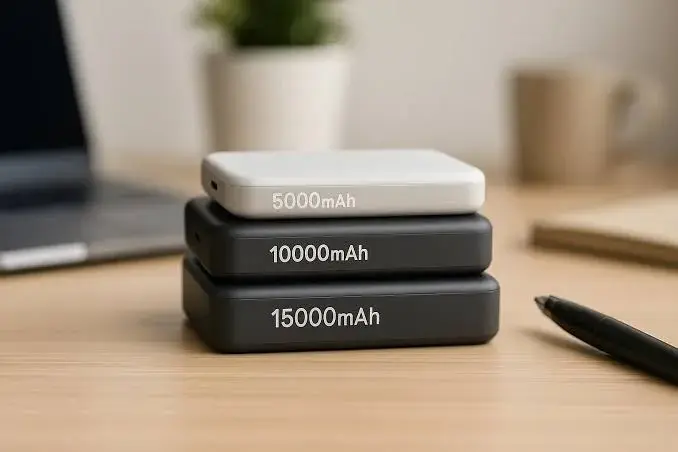
"How many times will it charge my phone?" is the first question almost everyone asks about a power bank, and the honest answer is "less than the number on the box suggests". A power bank printed 20,000 mAh does not give your phone 20,000 mAh. Between the voltage conversion, heat, the cable and your phone's own charging circuit, a good share of the stored energy is lost. Fake and exaggerated capacity claims make the problem worse. This power bank capacity guide shows you how to turn the numbers on the box into real-world charges, how to size a power bank for a phone, a laptop, a router or a trip, and how to catch inflated claims.
We are City Gadgets Kenya, at New Alnoor Exhibition, Second Floor, Shop C7, Accra Road, Nairobi CBD, with same-day delivery in Nairobi and next-day delivery outside Nairobi. We stock genuine Anker power banks. All calculations below are our own estimates from stated assumptions, not maker promises, and the Anker figures are "per Anker". Prices change, so message us on WhatsApp for today's price.
The short version
- mAh is only half the story. Watt-hours (Wh) is the fairer measure of stored energy: Wh ≈ mAh × 3.7 ÷ 1,000.
- Expect to use about two-thirds of the printed capacity in real life. That is our rule of thumb. Your result will vary.
- Phones: 10,000 mAh is about one to two charges, 20,000 mAh is about three to four.
- Laptops: need both capacity and enough watts. Even 25,000 mAh gives roughly one charge for a typical thin laptop.
- Airlines care about Wh. Up to 100 Wh is usually allowed in carry-on; above that you need approval. Check your airline.
- Very high capacity at a very low price is a red flag. Real cells have size and weight.
| Printed capacity | Approximate energy | Typical best use |
|---|---|---|
| 5,000 mAh | 18.5 Wh | Emergency top-up |
| 10,000 mAh | 37 Wh | Day carry, one to two phone charges |
| 20,000 mAh | 74 Wh | Heavy phone use, tablets, a couple of days |
| 25,000 mAh | 92.5 Wh | Phones plus a laptop top-up |
| 26,250 mAh | about 97 Wh | Laptop-capable, frequent travellers |
These are our calculations from printed capacity and a 3.7 V nominal cell voltage.
mAh, voltage and Wh: the maths in plain words
What mAh measures
A milliamp-hour is a unit of electric charge: a battery that can supply 1,000 mA (1 amp) for one hour has a capacity of 1,000 mAh. The catch is that mAh does not say at what voltage. Two batteries with the same mAh can hold different energy if their voltages differ.
Energy in watt-hours
Energy (Wh) = charge (Ah) × voltage (V). Lithium cells in power banks run at a nominal 3.6 to 3.7 volts. So a 10,000 mAh cell pack holds about 10 Ah × 3.7 V = 37 Wh. Your phone's battery is also a 3.7 V-class cell, so comparing mAh with mAh is fair between a power bank's cells and a phone's battery in principle, and the real difference shows up in the losses.
Why not all the energy reaches your phone
The cells inside the power bank run at about 3.7 V. USB output is at 5 V or higher, so a circuit boosts the voltage. The cable and connectors have resistance. The phone's charging circuit converts power again. Each step wastes some energy as heat. Typical overall efficiency is often somewhere around 60 to 70 per cent, depending on the power bank, the charging speed, the cable and the phone. We use 65 per cent as a planning figure, which is an assumption, not a measured value for any specific product. Anker publishes lab figures for some models, such as about 3.7 charges for an iPhone 16 and about 4.2 for a Samsung S24 from the Anker Zolo 20K, per Anker, which are for particular phones under Anker's test conditions.
Efficiency is usually lower at very high speeds and in hot conditions, and a little better at moderate speeds.
How many phone charges will you get?
The table shows our estimate of full charges for different power bank sizes and phone battery sizes, using 65 per cent efficiency. Phone batteries vary, so find your phone's battery capacity in its specifications.
| Power bank | 3,000 mAh phone | 4,000 mAh phone | 5,000 mAh phone | 6,000 mAh phone |
|---|---|---|---|---|
| 5,000 mAh | 1.1 | 0.8 | 0.7 | 0.5 |
| 10,000 mAh | 2.2 | 1.6 | 1.3 | 1.1 |
| 20,000 mAh | 4.3 | 3.2 | 2.6 | 2.2 |
| 25,000 mAh | 5.4 | 4.1 | 3.2 | 2.7 |
| 26,250 mAh | 5.7 | 4.3 | 3.4 | 2.8 |
If you start charging when your phone is at 20 per cent, you only need 80 per cent of a charge each time, so the number of top-ups is higher than these full-charge counts. Heavy phone use while charging, such as video or navigation, consumes some of the power too.
Reading it for yourself: divide the printed capacity by 1.5, then divide by your phone's battery capacity. For a 20,000 mAh bank and a 5,000 mAh phone: 20,000 ÷ 1.5 ≈ 13,300, and 13,300 ÷ 5,000 ≈ 2.7 charges. That matches the table within rounding.
How much capacity for tablets and earbuds?
Earbuds and watches. Their batteries are tiny. Case batteries are often a few hundred mAh, and a watch battery is a few hundred mAh. A 10,000 mAh bank can charge them many times, so the size of the bank is not the issue. Some small devices turn off if the current is too low, so a power bank with a low-current or trickle-charging mode is useful. We confirm per unit whether a model has one.
Tablets. Tablet batteries commonly range from about 5,000 to over 10,000 mAh. A 20,000 mAh bank gives roughly one to two tablet charges.
Cameras and drones. These use their own battery packs and chargers. A power bank with AC output or high-watt USB-C can power a charger, but most pocket banks cannot. Check the charger's input requirements.
How much capacity for a laptop?
A laptop battery is measured in Wh, so we compare with the power bank's Wh directly. Thin laptops commonly have batteries of roughly 40 to 70 Wh, though yours may differ. Using 65 per cent efficiency:
| Power bank | 40 Wh laptop | 50 Wh laptop | 60 Wh laptop | 70 Wh laptop |
|---|---|---|---|---|
| 10,000 mAh (37 Wh) | 0.6 | 0.5 | 0.4 | 0.3 |
| 20,000 mAh (74 Wh) | 1.2 | 1.0 | 0.8 | 0.7 |
| 25,000 mAh (92.5 Wh) | 1.5 | 1.2 | 1.0 | 0.9 |
| 26,250 mAh (about 97 Wh) | 1.6 | 1.3 | 1.1 | 0.9 |
These are charges from empty to full. In practice you top up from, say, 20 per cent, so you get more top-ups than the table suggests, and running the laptop while charging reduces the net gain.
But capacity is not the only requirement. A laptop needs enough watts from the power bank, a USB-C port that supports Power Delivery at the right wattage and a suitable cable. The Anker Prime 26K 300W (up to 140 W per USB-C port) and the Anker 25K 165W are the laptop-capable models in our range, per Anker. A 20,000 mAh bank limited to 22.5 W or 30 W will not charge most laptops properly. See our best power bank guide and USB-C cable guide.
Can a power bank keep a Wi-Fi router running?
During outages, many people ask whether a power bank can keep the internet alive. It can, with conditions.
Most home routers run on 9 V or 12 V DC and draw roughly 6 to 20 W, though yours may differ. Check the label on your router's power adapter for voltage and current. A standard USB power bank outputs 5 V (or higher voltage steps over USB-C Power Delivery), so it cannot plug straight into a 12 V router. Special "mini UPS" boxes and USB-to-DC step-up cables exist that convert a power bank's output to 9 V or 12 V. These work only if the voltage and the plug size match your router, and cheap cables can fail or damage equipment, so ask us before you buy one.
For a rough runtime estimate, take the power bank's usable energy and divide by the router's power draw. A 20,000 mAh bank holds about 74 Wh, and at 65 per cent efficiency about 48 Wh is usable. A 12 W router would run for about 4 hours, and a 20 W router for about 2.4 hours. These are our estimates, and conversion losses for a step-up cable could reduce them.
If you rely on the internet for work, a proper UPS or a router-sized battery backup is more dependable than improvising with a power bank. Our UPS guides explain how to choose, including UPS VA vs watts and how long will a UPS run.
How long does it take to recharge the power bank?
Capacity is useless if you cannot refill it. Recharge time depends on the bank's size, the charger's wattage and the bank's maximum input speed. A rough estimate is the bank's Wh divided by the charger's watts, plus about 15 per cent for losses. The table shows best-case estimates, which assume the power bank can accept that charging speed. Many banks accept less, and charging slows as the battery fills.
| Power bank | 10 W charger | 18 W | 30 W | 45 W | 65 W |
|---|---|---|---|---|---|
| 5,000 mAh | 2.2 h | 1.2 h | 0.7 h | 0.5 h | 0.3 h |
| 10,000 mAh | 4.4 h | 2.4 h | 1.5 h | 1.0 h | 0.7 h |
| 20,000 mAh | 8.7 h | 4.8 h | 2.9 h | 1.9 h | 1.3 h |
| 25,000 mAh | 10.9 h | 6.0 h | 3.6 h | 2.4 h | 1.7 h |
| 26,250 mAh | 11.4 h | 6.3 h | 3.8 h | 2.5 h | 1.8 h |
These are our best-case estimates. Real times are usually longer. The Anker Prime 26K can recharge at up to 250 W using both USB-C ports together, per Anker, which needs suitable high-power chargers and cables. The Anker Zolo 20K supports pass-through, so you can charge a device while the bank itself recharges, per Anker.
Practical advice: if you recharge overnight, even a 10 W charger can refill a mid-size bank. If you need quick turnarounds, pair the power bank with a fast charger that matches its input rating. Our fast charger guide and GaN charger guide explain how to choose.
Matching capacity to your day
The commuter
Phone use is moderate, mostly messaging, music and maps. A 10,000 mAh bank is plenty, giving one to two charges. If you forget to charge at home, it covers you for two days.
The student
Long days on campus with a phone and perhaps a tablet. A 10,000 to 20,000 mAh bank is a good fit, depending on how heavily you use the phone and whether you need to charge earbuds and a tablet.
The field worker or delivery rider
Navigation, calls and payments run the battery down fast. A 20,000 mAh bank keeps a phone going all day and into the next. Keep it in a bag away from heat.
The business traveller
A phone, a laptop and earbuds. A 25,000 mAh bank with high output, such as the Anker 25K 165W or the Anker Prime 26K, covers a phone several times and gives the laptop one top-up.
The photographer or content creator
A phone, a camera charger, a drone and a tablet. Capacity matters, and so do ports and watts. A larger bank with multiple USB-C ports is the sensible choice.
The weekend traveller
A phone and earbuds for two or three days away from sockets. A 20,000 mAh bank covers it comfortably.
The family on a road trip
Several phones and tablets. A car charger plus a 20,000 mAh bank. See our Anker car charger in the accessories category.
Size and weight versus capacity
Capacity has a physical cost. Lithium cells hold a certain energy per kilogram, and that is not changing quickly. As a rough guide, a 10,000 mAh power bank is often around 200 to 250 g, and a 20,000 mAh bank is often around 350 to 500 g, though designs differ. The Anker Prime 26K is heavier and larger because of its capacity and its 300 W electronics. We confirm weights per unit.
This is a useful fake detector: if a power bank is very small and light yet claims 30,000 mAh or more, it is almost certainly exaggerated. Cells have to fit inside.
Capacity claims: honest labels versus inflated ones
A genuine power bank's label shows its capacity in mAh and often Wh, its input and output ratings, its model number and certification marks. Inflated claims typically show:
- A capacity far above what the size and weight could hold.
- Unrealistic figures such as 50,000 mAh in a pocket-sized case.
- A capacity printed in large letters with no Wh, no output ratings and no model number.
- A label that disagrees with the box.
- No certification marks.
Independent testers regularly find cheap unbranded power banks delivering a fraction of their claimed capacity. A real 10,000 mAh Anker will typically deliver more usable energy than an unbranded "30,000 mAh" unit. That is why buying from a trusted brand matters more than chasing the biggest number.
Capacity and airlines
Airlines limit power banks by energy, in Wh. The common rule is that power banks go in carry-on baggage, up to 100 Wh is usually allowed, and 100 to 160 Wh may need airline approval, with limits on the number you can carry. Rules differ between airlines and countries and change over time, so check your airline's current policy before you travel.
From our calculations, a 20,000 mAh bank is about 74 Wh and a 25,000 mAh bank is about 92.5 Wh, both under 100 Wh. A 26,250 mAh bank is about 97 Wh, close to the limit. Look for the Wh figure on the label itself. Anker describes the Prime 26K as airline-safe, per Anker, but the airline's rules still apply. A bank labelled 30,000 mAh could exceed 100 Wh, which is another reason to check labels.
Temperature, age and real-life capacity
A power bank's usable capacity falls with:
- Cold or hot weather. Lithium cells deliver less in the cold and age faster in heat.
- Age and cycles. After a few hundred full cycles, capacity declines noticeably.
- High-speed discharge. Pulling power fast is less efficient.
- Poor cables. Long, thin or cheap cables waste energy.
- Pass-through use. Charging devices while the bank recharges can affect efficiency and heat.
Plan for less than the table on a bad day, and expect an old power bank to give less than a new one.
Choosing the right power bank: a step-by-step method
- List what you charge: phone, tablet, earbuds, laptop, router.
- Find each device's battery size, in mAh or Wh, from its specifications.
- Decide how many full charges you want between wall charges. For most people, one to three.
- Add the energy and divide by 0.65 to allow for losses, then convert to mAh by dividing Wh by 3.7 and multiplying by 1,000.
- Check the output watts needed, especially for a laptop or tablet.
- Check the ports: USB-C for modern devices, plus USB-A if you have older cables.
- Check the weight and airline status.
- Buy genuine from a seller with a shop, receipt and warranty.
Example: a phone with a 5,000 mAh battery (18.5 Wh), two full charges needed, no laptop. Energy needed = 2 × 18.5 = 37 Wh. Divide by 0.65 = 57 Wh. Convert to mAh: 57 ÷ 3.7 × 1,000 ≈ 15,400 mAh. A 20,000 mAh bank fits with room to spare, while a 10,000 mAh bank would fall short. These are our estimates.
Anker power banks in our range
We confirm model, version and ports per unit. Figures are per Anker or retailer listings.
- Anker Prime 26K 300W: 26,250 mAh, up to 300 W total, two USB-C and one USB-A, up to 140 W per USB-C port, recharge up to 250 W, smart display, app, airline-safe.
- Anker 25K 165W (A1695): 25,000 mAh, up to 165 W, built-in and retractable cables.
- Anker Zolo 20K (A110E): 20,000 mAh, up to 22.5 W, built-in USB-C cable about 7 inches, pass-through, about 3.7 iPhone 16 and 4.2 Samsung S24 charges in Anker's lab tests.
- Anker 20K 30W: 20,000 mAh, 30 W.
- Anker Zolo 10K 30W: 10,000 mAh, 30 W, built-in USB-C cable about 5.4 inches.
- Anker MagGo 10,000 mAh: magnetic wireless charging for compatible phones, with a Slim 10K version that is Qi2-certified for up to 15 W, per a retail listing.
For comparisons and recommendations by use, read our best power bank in Kenya guide.
Wireless and magnetic charging: capacity runs out faster
Wireless charging is convenient, but it is less efficient than a cable, because some energy is lost as heat between the coils. A magnetic wireless power bank such as the Anker MagGo will therefore give fewer phone charges than a cable-connected bank of the same capacity. As a planning guide, expect noticeably fewer charges, and treat the printed capacity with extra caution. The exact loss depends on the model, the phone, the case and alignment. If your priority is the maximum number of charges, use a cable. If your priority is convenience, wireless is fine, and a 10,000 mAh MagGo gives a top-up or so, per Anker's description of the product. We confirm per unit.
Using a power bank while you charge it, and while you use your phone
Pass-through charging, where the bank charges a device while it is itself plugged in, is handy at a desk or at the airport. It does not store extra energy, and it can make the bank warm. If you use a phone for video calls or navigation while it charges, a good portion of the incoming power goes to running the phone, so the battery fills slowly or even drains if the charging speed is low. For a long drive, use a car charger with enough watts. Our Anker car charger in the accessories category offers up to 67 W in total, per Anker, and we confirm the port split per unit.
Storing and caring for capacity
To keep a power bank's capacity healthy:
- Store it around half to two-thirds charged if you will not use it for weeks.
- Top it up every few months, because lithium batteries slowly self-discharge.
- Avoid leaving it at 0 per cent for long periods.
- Keep it away from heat, such as dashboards and direct sun.
- Do not use a bank that is swollen, hot or damaged.
- Replace very old banks, since they lose capacity and can be less safe.
Capacity for families, elderly relatives and shared use
Households with several phones, or relatives who forget to charge, benefit from one or two mid-size banks kept in a known place. A 10,000 mAh bank in a handbag is easy for an older relative to use, with a short built-in cable like the one on the Anker Zolo 10K, per Anker, so there is nothing to lose. A 20,000 mAh bank on a shelf at home is a good power-cut backup for phones, a torch and earbuds. Label the bank with the date you last charged it, and test it monthly.
Common capacity mistakes
- Believing the printed mAh equals phone charges. Divide by about 1.5, as a guide.
- Buying on mAh alone and ignoring output watts, so the bank cannot charge a laptop or tablet quickly.
- Choosing a huge capacity you will never use, then carrying the weight.
- Forgetting airline limits and arriving at the airport with a bank over 100 Wh.
- Trusting an unbranded label with a capacity too large for the size.
- Ignoring recharge time, then finding the bank empty when you need it.
- Using a weak cable and blaming the bank.
- Leaving the bank in a hot car, which shortens life and can be unsafe.
- Never topping up a bank stored for months.
- Skipping the receipt and warranty.
Questions to ask any seller before you pay
- Is this a genuine Anker product, and is the box sealed?
- What are the capacity in mAh and Wh, and the maximum output in watts, per port and in total?
- How many charges of my phone or tablet will it give, on the maker's stated test?
- How fast does it recharge, and with which charger?
- Is it allowed on flights?
- Which cables does it need to reach full speed?
- What warranty applies and who services it?
- Can I see the label and the ports?
How to spot a fake or exaggerated power bank capacity
Capacity is the most commonly faked number on a power bank. Use these ten checks together.
- Check weight against capacity. A power bank with a large claimed capacity should feel substantial. Compare it with a genuine unit of similar claimed size.
- Check the label. It should list a model number, capacity in mAh and preferably Wh, input and output ratings and certification marks. A label with only a big number is suspect.
- Check the maths on the label. The listed output and input should be consistent with the capacity. Wh should be close to mAh × 3.7 ÷ 1,000.
- Check the packaging. Genuine boxes have sharp printing, accurate model names and clean seals. Spelling mistakes and blurry logos are red flags.
- Check the model number on the maker's website.
- Check the print and build. Rough seams, uneven ports and smudged text suggest a copy.
- Test it. Fully charge a genuine bank and a suspect one, and see how many phone charges each delivers. A real 20,000 mAh bank should give a few charges for a typical phone. A fake may give less than one.
- Check the display or app on models that have one, such as the Prime 26K's smart display. It should work and show sensible values.
- Check the seller and warranty. A genuine seller has a shop address, gives a receipt and states the warranty period.
- Check the price. Very high capacity at a very low price is a red flag.
If you are unsure, bring the power bank to New Alnoor Exhibition, Second Floor, Shop C7, Accra Road, and we will help you check it.
Why buy your power bank from City Gadgets Kenya
- Genuine Anker power banks, checked before they reach you.
- A real shop at New Alnoor Exhibition, Second Floor, Shop C7, Accra Road, Nairobi CBD, opening from 9:00 AM.
- Same-day delivery in Nairobi and next-day delivery outside Nairobi.
- M-Pesa payment and clear receipts.
- Honest advice, including telling you when a smaller bank is enough.
- Capacity sizing. Tell us your devices and we will work out what you need.
- Chargers and cables in our accessories category.
- Support and repairs through our repair service.
- Trade-ins through our sell page.
- WhatsApp help on +254745575931.
Your capacity checklist
- I know my devices' battery sizes.
- I decided how many charges I need between wall charges.
- I allowed for losses by dividing the printed capacity by about 1.5.
- I checked the output watts for any tablet or laptop.
- I checked airline limits in Wh if I will fly.
- I checked the label, weight and box for signs of an exaggerated claim.
- I have a receipt and know the warranty terms.
Frequently asked questions
How many mAh do I need for my phone? About 10,000 mAh for one to two charges, and 20,000 mAh for three to four, by our estimate.
Why does my 10,000 mAh power bank not charge my phone twice? Conversion losses, cable losses and phone charging losses reduce what reaches the battery, so about 1.3 charges of a 5,000 mAh phone is typical, by our estimate.
What is the difference between mAh and Wh? Wh accounts for voltage and is the fairer measure of energy. Wh ≈ mAh × 3.7 ÷ 1,000.
Can a 20,000 mAh power bank charge a laptop? Only if it supplies enough watts over USB-C, and even then it gives roughly one charge or less. High-output banks like the Prime 26K and 25K 165W are the right choice.
Can I take a 20,000 mAh power bank on a plane? It is about 74 Wh, within the common 100 Wh limit. Check your airline.
How long does a power bank take to recharge? It depends on size and charger. A 20,000 mAh bank may take around 3 hours with a 30 W charger at best, and longer with slow chargers.
Can I use a power bank for my router? Only with the right voltage conversion. Ask us first.
Does capacity decline over time? Yes, after hundreds of cycles.
Can I pay by M-Pesa? Yes.
How do I know it is genuine? Use the ten checks above.
Where can I buy a power bank in Nairobi? At City Gadgets Kenya, Shop C7, Second Floor, New Alnoor Exhibition, Accra Road.
Ready to choose?
Message us on WhatsApp with your devices and how long you are away from a socket, and we will size the right power bank for you.
Related reading: Best power bank in Kenya · Best fast charger in Kenya · Best USB-C cable in Kenya · Best UPS for a home office