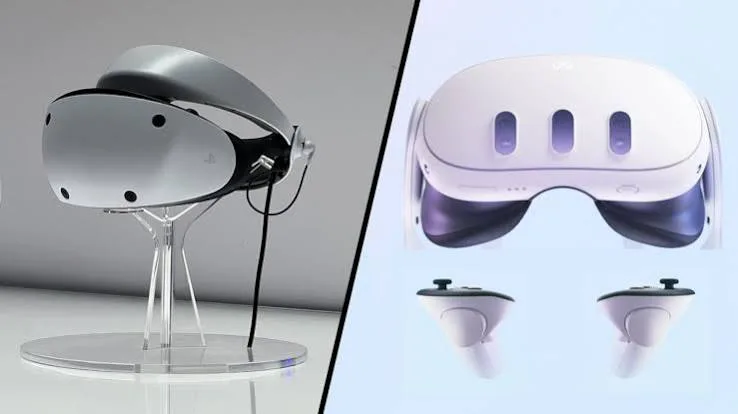
Meta Quest 3 vs Quest 3S vs PSVR2: The Complete VR Headset Guide for Kenya
Virtual reality in Kenya effectively comes down to two ecosystems: Meta's standalone Quest headsets, which need nothing but themselves to work, and Sony's PSVR2, which plugs into a PS5 (or, more recently, a capable PC) for a tethered, higher-fidelity experience. Within Meta's own lineup, there's a further choice between the Quest 3 and the more affordable Quest 3S. This guide breaks down the specs of all three headsets, current Kenyan pricing, where each one genuinely wins, and — the question most people actually want answered — whether Meta or Sony is the better VR buy in Kenya right now.
Meta Quest 3: Specs and What It's Built For
The Quest 3 remains Meta's flagship standalone headset and the current benchmark of the Quest lineup, especially with the Quest 4 pushed out to at least 2027–2028.
Key specs:
- Qualcomm Snapdragon XR2 Gen 2 chipset with 8GB RAM
- 4K+ Infinite Display — 2064 x 2208 resolution per eye, 90–120Hz refresh rate
- Pancake lenses with continuous IPD adjustment (58–72mm) for sharper optics and better comfort during long sessions
- Full-color mixed reality passthrough via dual RGB cameras and a depth sensor
- 512GB storage (the only capacity currently in production)
- Touch Plus controllers with TruTouch haptic feedback, ring-free design
- Built-in 3D spatial audio, no headphones required
- Wi-Fi 6E, Bluetooth
- Roughly 2.2 hours of battery life per charge
- Weight: approximately 515g
Who it's for: Buyers who want the sharpest visuals and best mixed-reality passthrough currently available in a standalone headset — genuinely worth the premium if you care about text clarity, productivity apps, or extended gaming and media sessions.
Price in Kenya: The Quest 3 (512GB) is currently listed by Kenyan retailers from roughly KES 55,000 to KES 76,000, depending on retailer.
Meta Quest 3S: Specs and What It's Built For
The Quest 3S is Meta's budget-focused headset, sharing the Quest 3's core processing power while cutting costs on optics and storage.
Key specs:
- Same Qualcomm Snapdragon XR2 Gen 2 chipset and 8GB RAM as the Quest 3 — identical raw processing performance
- 1832 x 1920 resolution per eye, using Fresnel lenses instead of pancake lenses — noticeably less sharp, with visible "god rays" (light halos) in high-contrast scenes
- Full-color mixed reality passthrough, same core feature set as Quest 3
- 128GB or 256GB storage options
- Touch Plus controllers with TruTouch haptics — identical controllers to the Quest 3
- Roughly 2.5 hours of battery life per charge
- Weight: approximately 514g
Who it's for: First-time VR buyers, casual gamers, and budget-conscious households who want genuine current-generation Meta Horizon OS access without paying Quest 3 prices — the performance is identical, only the display sharpness and storage take a step down.
Price in Kenya: The Quest 3S is currently listed by Kenyan retailers from roughly KES 41,999 to KES 54,000, depending on storage capacity and retailer, making it the most affordable current-generation VR headset available in Kenya today.
Quest 3 vs Quest 3S: The Real Difference
Both headsets run on identical hardware underneath — same chip, same RAM, same controllers, same game library. The entire decision comes down to two things: lens quality and storage.
The Quest 3's pancake lenses deliver noticeably sharper image quality, better edge-to-edge clarity, and more comfortable continuous IPD adjustment — genuinely important if you read text in VR, use productivity or simulation apps, or are simply picky about visual sharpness. The Quest 3S's Fresnel lenses are a clear step down in optical quality, similar to the older Quest 2 generation, with visible light artifacts in bright scenes — though for casual gaming and media consumption, most users find the difference less noticeable than it sounds on paper.
Verdict: Buy the Quest 3S if you're new to VR, budget-conscious, or mainly playing games and watching media where pixel-level sharpness isn't your priority. Buy the Quest 3 if you care about visual clarity, do a lot of mixed reality or productivity work, or want the best optics Meta currently ships in a standalone headset.
Sony PSVR2: Specs and What It's Built For
PSVR2 takes a fundamentally different approach — a tethered headset built around PS5's processing power rather than running everything on the headset itself.
Key specs:
- Dual OLED displays, 2000 x 2040 resolution per eye, 90Hz or 120Hz refresh rate — genuinely higher resolution and superior contrast (true blacks) compared to either Quest headset's LCD panels
- 110° field of view
- Eye tracking built into the headset — enables foveated rendering (sharper detail exactly where your eyes are looking) and emotionally expressive avatars in supported games
- Inside-out tracking via four outward-facing cameras — no external sensors needed
- Headset feedback — a single built-in vibration motor that adds physical sensation to in-game events, a feature neither Quest headset offers
- PlayStation VR2 Sense controllers with adaptive triggers, finger touch detection, and haptic feedback — or standard DualSense controllers work for many titles too
- Single-cable connection to PS5 — no separate power brick or battery to manage
- PC compatibility via an official adapter (launched August 2024), extending the headset's use beyond PS5 into SteamVR's much larger PC library
- Weight: approximately 560g
Who it's for: PS5 owners who want the sharpest, most contrast-rich visual experience currently available in consumer VR, don't mind being tethered by a cable, and are drawn to Sony's narrower but high-production-value exclusive VR library.
Price in Kenya: PSVR2 pricing varies significantly across Kenyan retailers — from around KES 48,000 at the low end up to KES 100,000 at some sellers, with most genuine units clustering between KES 55,000 and KES 79,999. It's worth shopping around carefully here, since the spread is unusually wide for what is fundamentally the same product across retailers.
Where PSVR2 Genuinely Beats Quest 3 and Quest 3S
It's worth being specific about this rather than just calling one "better," because the advantages are real and concrete:
Display quality. PSVR2's OLED panels deliver true blacks and dramatically better contrast than the LCD panels in either Quest headset — a genuine, immediately visible difference in dark or atmospheric games.
Eye tracking and foveated rendering. Neither Quest 3 nor Quest 3S includes eye tracking. On PSVR2, this enables the headset to render fine detail only where you're actually looking, improving both visual fidelity and performance efficiency — plus more expressive multiplayer avatars.
Headset feedback (haptics in the headset itself). PSVR2's built-in vibration motor adds a physical sensation layer — arrows whizzing past, engine rumble — that neither Meta headset replicates. It's a small detail that meaningfully changes immersion in supported titles.
No battery anxiety. Because PSVR2 draws power through its cable connection to the PS5, you never have to think about charging it mid-session — a real practical advantage over the Quest headsets' roughly 2–2.5 hour battery life.
Processing power. Since PSVR2 offloads all rendering to the PS5 rather than an onboard mobile chipset, it can push considerably more graphical detail than a standalone headset ever could — genuinely closer to high-end PC VR quality than anything Quest's mobile hardware can achieve on its own.
Where Quest 3 and Quest 3S Beat PSVR2
Meta's headsets counter with advantages that matter just as much for a large share of buyers:
No PS5 required. This is the single biggest practical factor for most Kenyan buyers. Quest 3 and Quest 3S are complete, standalone systems — buy the headset and you're playing within minutes. PSVR2 requires a PS5 (itself a KES 80,000+ purchase) or a capable gaming PC with an official adapter, meaningfully raising the real total cost of entry if you don't already own one.
True wireless freedom. No cable tethering you to a console or PC — you can move freely around a room without tripping over anything, genuinely important for fitness apps, room-scale games, and simply being comfortable during long sessions.
A much larger, more diverse content library. The Meta Horizon Store has a considerably larger and more varied catalog of VR titles than PSVR2's currently more focused, narrower library — even with PSVR2's library maturing meaningfully through 2026.
Lower total cost of entry. A Quest 3S at roughly KES 42,000–54,000 is genuinely the cheapest way into current-generation VR in Kenya, full stop — no console, no PC, no adapter required.
Broader everyday utility. Beyond gaming, Quest headsets double as a personal cinema screen, a virtual multi-monitor productivity setup, and a social/fitness platform in ways that PSVR2, tied to a single PS5 in one room, generally can't match.
Side-by-Side Summary
| Meta Quest 3 | Meta Quest 3S | PSVR2 | |
|---|---|---|---|
| Display type | LCD, pancake lenses | LCD, Fresnel lenses | OLED |
| Resolution per eye | 2064 x 2208 | 1832 x 1920 | 2000 x 2040 |
| Eye tracking | No | No | Yes |
| Standalone (no host device) | Yes | Yes | No — needs PS5 or PC |
| Wireless | Yes | Yes | No — cabled |
| Headset haptics | No | No | Yes |
| Kenya price (headset only) | ~KES 55,000 – 76,000 | ~KES 41,999 – 54,000 | ~KES 48,000 – 100,000 |
| Realistic total cost of entry (no existing console/PC) | Headset price only | Headset price only | Headset + PS5 (~KES 80,000+) |
So, Which Should You Actually Buy?
Buy a Quest 3 or Quest 3S if: you want the simplest, cheapest way into VR with no other hardware required, value wireless freedom, want the widest content library, or plan to use the headset for productivity and mixed reality as much as gaming.
Buy a PSVR2 if: you already own a PS5 (making the real added cost just the headset itself), want the sharpest and most contrast-rich visuals available in consumer VR, care about eye tracking and headset haptics, and don't mind being tethered by a cable for a more graphically powerful experience.
Between Quest 3 and Quest 3S specifically: choose the 3S if budget is tight and you're new to VR; choose the Quest 3 if visual sharpness and mixed-reality quality matter enough to justify the price gap.
And If You Already Own a PS5
This is genuinely the deciding factor for a lot of Kenyan buyers. If you already have a PS5 sitting under your TV, PSVR2 becomes a far more competitive option — you're only paying for the headset itself (as little as KES 48,000–79,999 depending on retailer), and you get access to a growing, high-production-value exclusive VR library plus the option to extend it further into SteamVR's much larger catalog via the official PC adapter. If you don't already own a PS5 or a VR-capable gaming PC, a Quest headset is almost always the more sensible, lower-friction entry point into VR.
You can browse current PSVR2 and PS5 stock at City Gadgets Kenya's Gaming category if you're weighing whether to buy both together.
Buying Safely: What to Check Before You Buy Any VR Headset in Kenya
VR headsets are a smaller, more specialized category than phones or consoles in Kenya's retail market, which makes due diligence just as important:
- Confirm exactly which Quest 3S storage variant you're buying. Kenyan listings for the Quest 3S sometimes don't clearly state whether it's the 128GB or 256GB model — confirm before paying, since the price difference is meaningful.
- Check that the price includes both controllers and a charging cable. Both Meta headsets and PSVR2 should come complete with their respective controllers — don't assume a headset-only listing includes everything you need to start playing.
- Verify PSVR2 pricing carefully across multiple retailers. As shown in the table above, PSVR2 pricing in Kenya varies unusually widely — sometimes by KES 40,000 or more between sellers for what should be the same product — so this is a category worth comparison shopping harder than most.
- Ask about warranty coverage. Genuine Meta and Sony hardware should carry manufacturer warranty coverage, honored locally or through the retailer directly.
- Confirm you have a genuinely comfortable play space if going PSVR2's route. Since it requires inside-out camera tracking and a cable connection to your PS5, a dedicated, reasonably sized, well-lit room works best — cluttered or overly bright spaces can affect tracking quality.
- Check payment flexibility. Reputable Kenyan electronics retailers generally accept M-Pesa alongside card payments.
Frequently Asked Questions
Which is better, Meta Quest 3 or Quest 3S? They share identical processing power — the difference is entirely in display quality (Quest 3's pancake lenses are noticeably sharper) and storage. Quest 3S is the better budget pick; Quest 3 is worth the premium if visual clarity matters to you.
Is PSVR2 better than Meta Quest 3? PSVR2 has superior display technology (OLED vs LCD), eye tracking, and headset haptics that neither Quest headset offers, plus more raw graphical power via the PS5. But it requires a PS5 or capable PC and a cable connection, while Quest 3 is a complete wireless system on its own — "better" genuinely depends on whether you already own a PS5.
Do I need a PS5 to use PSVR2? Yes, for the primary experience — PSVR2 was designed exclusively for PS5. An official PC adapter, launched in 2024, does extend compatibility to Windows PCs meeting specific GPU and port requirements, but the PS5 remains the primary and simplest way to use it.
Which VR headset is cheapest in Kenya? The Meta Quest 3S is the cheapest current-generation VR headset in Kenya, starting around KES 41,999–46,000, with no additional hardware required to use it.
Can I use PSVR2 without buying Sense controllers separately? No separate purchase needed — PSVR2 Sense controllers are included with the headset, and standard PS5 DualSense controllers also work with many titles that don't require the specialized finger-tracking features.
Where can I buy a genuine Quest or PSVR2 headset with warranty in Kenya? City Gadgets Kenya's Gaming category stocks Meta Quest and PSVR2 hardware with warranty — reach out via WhatsApp to check current stock and pricing.
Final Verdict
There's a genuinely different right answer depending on what you already own and what you want from VR. If you're starting from zero and want the simplest, cheapest, most flexible way into virtual reality, a Meta Quest headset — the 3S if budget is tight, the Quest 3 if you want sharper visuals — is the clear pick, and arguably the better VR headset for most Kenyan buyers specifically because it needs nothing else to work. If you already own a PS5 and want the single sharpest, most immersive VR experience currently available at a reasonable added cost, PSVR2 is genuinely the more capable headset on pure hardware terms — OLED display, eye tracking, and headset haptics that Meta simply doesn't offer yet.
For the average first-time buyer in Kenya without an existing PS5, the Meta Quest lineup is the more practical and cost-effective choice. For an existing PlayStation household looking to extend their setup, PSVR2 is a genuinely excellent, higher-fidelity add-on rather than a separate purchase to budget for from scratch.
Browse current Meta Quest and PSVR2 stock at City Gadgets Kenya's Gaming category, or reach out on WhatsApp if you'd like help deciding which headset fits your setup and budget.