Convertible laptop terminology has genuinely proliferated faster than most buyers can keep track of — X360, Yoga, 2-in-1, detachable, hybrid — terms that get used almost interchangeably in casual conversation despite describing genuinely different mechanical approaches to the same broad idea: a laptop that can transform beyond its standard clamshell form. This piece is a clear, honest technical explainer of what each term genuinely means, building on the practical buying advice in our dedicated convertible laptop buying guide, using real examples from City Gadgets Kenya's catalog.
The Core Concept: Why Convertible Laptops Exist at All
Before distinguishing the specific mechanisms, it's worth explaining the underlying idea these designs all share. A standard laptop is optimised for one primary posture — open at roughly a 90-110 degree angle, keyboard facing up, for typing-focused use. Tablets, by contrast, are optimised for a completely different interaction model — flat or handheld, touch-driven, without a physical keyboard in the way. Convertible laptops represent genuine engineering attempts to deliver both experiences from a single device, avoiding the cost and inconvenience of owning separate laptop and tablet devices for users who genuinely want both capabilities.
Hinge-Based Convertibles: X360 and Yoga, Mechanically Explained
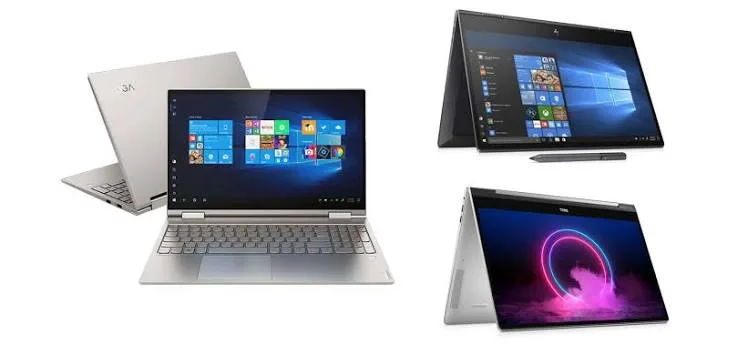
As covered in our dedicated convertible buying guide, HP's "X360" and Lenovo's "Yoga" naming both describe the same underlying mechanical approach: a genuine 360-degree hinge allowing the display to rotate all the way around and fold flat against the back of the keyboard.
The engineering challenge this represents: a standard laptop hinge only needs to support a relatively narrow range of motion — roughly 0 to 130-150 degrees for typical use. A 360-degree hinge must instead support the full rotational range while maintaining structural rigidity at every point along that rotation, resisting wobble in tablet mode, resisting sag in tent mode, and surviving many thousands of open-close-fold cycles over the laptop's working life without developing looseness — a genuinely more demanding mechanical engineering problem than a standard hinge design.
The four genuine postures this design enables, each with distinct practical value:
- Laptop mode — standard use, keyboard facing up, identical to a conventional laptop
- Tent mode — the device forms an inverted V-shape, useful for compact video calls or media viewing in tight spaces
- Stand mode — the keyboard folds flat underneath, screen upright, useful for media consumption without keyboard access
- Tablet mode — the screen folds completely back against the keyboard's underside, creating a genuine (if slightly thicker and heavier than a purpose-built tablet) touch-first device
Detachable Designs: The Microsoft Surface Pro Approach
As detailed in our convertible buying guide, detachable designs — exemplified by the Microsoft Surface Pro, available at City Gadgets Kenya — take a genuinely different mechanical approach: rather than a folding hinge, the keyboard physically separates entirely from the display unit, which contains all the laptop's actual computing hardware and functions as a complete, standalone tablet on its own.
The engineering trade-offs this creates: because the keyboard is a separate, passive accessory (typically containing no computing hardware of its own, simply a physical keyboard and trackpad connecting to the tablet via magnetic or pin connectors), the tablet portion alone is genuinely lighter than any hinge-based convertible's tablet mode, which must carry the keyboard's weight even when folded away and unused. The trade-off, as covered in our buying guide, is the practical inconvenience of a separate component that can be misplaced, alongside a kickstand mechanism (built into the tablet itself) replacing the tent/stand functionality a hinge-based design achieves through the hinge alone.
Understanding "2-in-1" as an Umbrella Term
It's worth clarifying that "2-in-1" itself isn't a specific mechanism — it's a broader marketing and category term Dell and other manufacturers use to describe any laptop offering both laptop and tablet-like functionality, encompassing both the hinge-based and detachable approaches described above. When Dell describes configurations like the Latitude 5300 2-in-1 or XPS 13 9310 2-in-1, available at City Gadgets Kenya, these specifically use the hinge-based mechanism described above, despite the more generic "2-in-1" terminology — worth confirming the specific mechanism directly, as covered in our buying guide, rather than assuming "2-in-1" alone specifies which engineering approach a given model uses.
The Genuine Engineering Cost of Convertible Functionality
It's worth explaining honestly why convertible laptops carry a genuine price premium over equivalent fixed-form configurations, beyond simply "extra features cost more" as a vague explanation.
Touchscreen hardware itself adds cost — the touch-sensitive layer over the display panel, along with the additional processing needed to interpret touch input accurately, represents genuine additional component and engineering cost beyond a standard non-touch display.
Reinforced hinge engineering, as discussed above, requires more sophisticated mechanical design and higher-quality materials than a standard laptop hinge, to survive the genuinely more demanding rotational stress and cycle count these designs experience.
Additional internal sensors, including accelerometers that detect the device's current orientation to automatically adjust the display rotation and input mode (disabling the keyboard in tablet mode, for instance), represent further genuine engineering and component cost beyond a standard fixed-form laptop's requirements.
Why This Matters for Refurbished Buyers Specifically
Connecting this technical explanation back to practical relevance for Kenya's refurbished laptop market: understanding these genuine mechanical differences helps buyers ask more precise, useful questions when evaluating a specific unit, as detailed in our convertible buying guide's testing section. Rather than simply asking "does it work," understanding that a 360-degree hinge experiences fundamentally different mechanical stress than a standard hinge means genuinely useful, specific verification questions — checking for hinge looseness across the full rotational range, confirming touch responsiveness across the entire screen rather than just the centre, and for detachable designs specifically, confirming the keyboard's magnetic or pin connection still makes reliable contact.
Pen and Stylus Support: A Related but Genuinely Distinct Capability
It's worth clarifying that touch input and active pen support are genuinely separate capabilities, sometimes conflated by buyers new to this category, as also noted in our convertible buying guide. Basic capacitive touch — responding to finger taps and swipes — is a relatively standard feature across most touchscreen laptops. Active pen support requires additional, specific hardware (typically an embedded digitizer layer using either Wacom's AES technology or Microsoft's Pen Protocol standard) capable of detecting a compatible stylus's position, pressure sensitivity, and sometimes tilt angle with considerably more precision than finger-based touch alone provides — a genuinely more sophisticated, and not universally included, capability worth confirming specifically if precise digital note-taking or sketching is your primary reason for considering a convertible or detachable device.
A Brief History: How Convertible Laptops Emerged as a Genuine Category
It's worth understanding briefly where this entire category originated, since it clarifies why the specific mechanisms discussed throughout this piece evolved the way they did. Early attempts at convertible computing in the 2000s were genuinely clunky by today's standards — bulky swivel-screen designs and early tablet PCs that compromised heavily on both laptop and tablet functionality without excelling at either. The genuine turning point came with the broader smartphone and tablet revolution of the early 2010s, which normalised touch-first interaction for a huge global user base and created consumer demand for laptops that could similarly support touch-driven use alongside traditional keyboard-and-mouse computing. Lenovo's original Yoga line, launched in 2012, is widely credited as the design that popularised the specific 360-degree hinge mechanism discussed throughout this piece, with HP's X360 branding and various Dell 2-in-1 designs following this same general engineering approach in subsequent years as the category matured into the genuinely refined, reliable designs now available in Kenya's refurbished market.
Why Some Manufacturers Chose Detachable Over Hinge-Based Designs
It's worth explaining Microsoft's specific reasoning for the Surface Pro's detachable approach, since understanding a manufacturer's design philosophy clarifies why these different mechanisms coexist rather than one simply replacing the other. Microsoft's original Surface concept was explicitly framed around the idea of "the tablet that can replace your laptop" — prioritising genuine tablet-first design, with the keyboard treated as an optional productivity accessory rather than an integral, always-present component. This philosophy directly shaped the detachable mechanism: a tablet that happens to support an excellent keyboard accessory, rather than a laptop that happens to fold into tablet shape. This distinct design philosophy explains genuine differences beyond the mechanism alone — Surface devices typically emphasise pen input and tablet-first software experiences slightly more than hinge-based convertibles, which more explicitly prioritise remaining excellent laptops first, with tablet mode as a valuable but secondary capability.
Durability Testing Considerations Specific to Each Mechanism
Building on the durability engineering discussion in our ThinkPad-focused piece, it's worth noting that convertible and detachable designs face genuinely distinct durability testing challenges beyond what standard laptops require. Hinge-based convertibles undergo specific cyclical testing simulating tens of thousands of full 360-degree rotations, verifying the hinge maintains structural integrity and doesn't develop looseness or wobble over years of use. Detachable designs face a different durability challenge specifically around the magnetic or pin connector mechanism joining keyboard to tablet, which must maintain reliable electrical contact and physical security across years of repeated attachment and detachment cycles — a genuinely different engineering problem than the hinge-cycling test convertibles undergo, explaining why buyers evaluating a refurbished unit of either type should focus their functional testing specifically on whichever mechanism that particular design actually uses, as detailed in our dedicated convertible buying guide's testing section.
Frequently Asked Questions
Is there a genuine mechanical difference between HP's "X360" and Lenovo's "Yoga" naming? No — both describe the same underlying 360-degree hinge mechanism, simply branded differently by each manufacturer, as detailed throughout this piece.
Which is genuinely lighter in tablet mode: a hinge-based convertible or a detachable design? Detachable designs are genuinely lighter in tablet mode, since the keyboard portion is left behind entirely, while hinge-based convertibles must carry the folded-away keyboard's weight even in tablet mode.
Does a 360-degree hinge genuinely wear out faster than a standard laptop hinge? It experiences more mechanical stress by design, given the greater range of motion and typical usage pattern, making hinge condition a genuinely more important check on refurbished convertible units, as detailed in our dedicated buying guide.
Is "2-in-1" a specific technical term or a general marketing category? A general category term encompassing both hinge-based and detachable designs — always confirm the specific mechanism directly rather than assuming "2-in-1" alone specifies which engineering approach is used.
Do all convertible and detachable laptops support active pen input? No — basic touch and active pen support are genuinely separate capabilities, as explained above, and should be confirmed specifically if precise stylus input matters to your intended use.
Is it worth the price premium for convertible functionality if I'm not certain I'll use tablet mode regularly? Generally not, as covered in our dedicated convertible buying guide — this functionality is worth paying for only when you have a genuine, regular use case for it, rather than as a speculative "might be nice" feature.
Which mechanism is generally considered more durable long-term, hinge-based or detachable? Both undergo genuine, rigorous durability testing for their respective mechanisms, as discussed above — neither is inherently more durable in an absolute sense, though each carries distinct failure modes worth checking specifically (hinge looseness for convertibles, connector reliability for detachables) when evaluating a refurbished unit.
Do convertible laptops cost more to repair than standard laptops if the hinge or touchscreen fails? Potentially, given the more specialised mechanical components involved, though this varies by specific model and the availability of replacement parts, similar to the repairability discussion in our ThinkPad-focused piece regarding business laptop serviceability generally.
Can I use a stylus with any touchscreen laptop, or does it need specific hardware support? As explained above, active pen input requires specific embedded digitizer hardware, not simply a touchscreen — confirm this specifically for any model where precise stylus use is a priority, rather than assuming any touchscreen supports it.
Is Microsoft's Surface Pro the only detachable design available in Kenya's refurbished market? It's the most widely recognised and available detachable design in Kenya's market specifically, though the broader detachable category includes other manufacturers' devices globally, even if less commonly found in Kenya's specific refurbished supply chain.
Explore Convertible and Detachable Laptops at City Gadgets Kenya
Every convertible and detachable laptop at City Gadgets Kenya, including hinge and touchscreen function, is fully tested and backed by a genuine 6-month warranty. Browse our laptops category or message us on WhatsApp to find the right convertible mechanism for your genuine needs.