
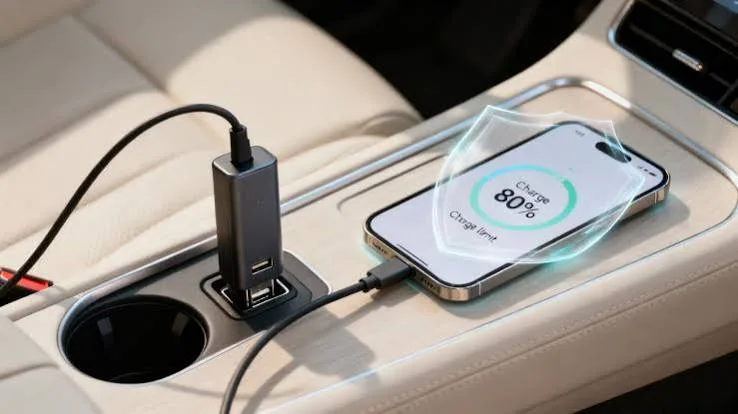
A car charger looks like the simplest accessory you can buy. You push it into the socket, plug in the phone and forget about it. But a car charger sits between a vehicle's electrical system and a lithium-ion battery in your phone, in a hot cabin, often unattended and often bought cheaply from a roadside seller. This guide to car charger safety explains how car chargers work, what can go wrong, how to choose a safe one in Kenya, and how to spot a fake.
We are City Gadgets Kenya, at New Alnoor Exhibition, Second Floor, Shop C7, Accra Road, Nairobi CBD, with same-day Nairobi delivery and next-day delivery outside Nairobi. Message us on WhatsApp for advice or today's price. This article is general education, not an electrical engineering specification. Vehicle wiring and fixed installations should be handled by a qualified auto electrician.
The short version
- A car charger converts your vehicle's 12 V supply (about 12 to 14.4 V while running, and higher on some trucks at 24 V) down to the 5 V or higher that your phone needs.
- Cheap, unbranded chargers are the main risk. They may lack proper protection, overheat, damage your phone or blow the car's fuse.
- Look for protection against over-voltage, over-current, short circuit and over-temperature, and recognised safety marks on the label.
- Match the charger to your phone. USB-C Power Delivery (PD) chargers charge modern phones fast. See our USB Power Delivery explained guide.
- Do not leave a charging phone on a hot dashboard. Heat is bad for batteries and for chargers.
- Do not use damaged cables or loose sockets.
- Unplug when you leave the car if your socket stays powered after the ignition is off.
| Risk | What causes it | How to reduce it |
|---|---|---|
| Overheating charger | Poor design, overload, hot cabin | Buy a quality charger, avoid covering it |
| Blown fuse | Short circuit, overload, faulty charger | Use a rated charger, replace fuses correctly |
| Phone damage | Unstable voltage, poor protection | Choose a protected, certified charger |
| Flat car battery | Socket live with engine off | Unplug the charger when parked |
| Cable fire risk | Frayed or cheap cable | Use quality cables and replace damaged ones |
How a car charger works
A car's electrical system is nominally 12 V DC. When the engine is running, the alternator raises this to roughly 13.5 to 14.5 V. A car charger plugs into the 12 V socket, originally called the cigarette lighter socket, and converts that voltage to the USB output your phone expects.
Inside the charger is a DC-DC converter, normally a small switching regulator. It steps the voltage down to 5 V for basic USB, or negotiates higher voltages such as 9 V, 12 V, 15 V or 20 V for fast charging protocols like USB Power Delivery or Quick Charge. A good charger includes protection circuits and filters to deal with the electrical noise that vehicles produce, such as voltage spikes when the engine starts or when heavy loads switch on.
The socket itself is typically protected by a fuse, commonly 10 A or 15 A on many vehicles. Check your owner's manual for the exact rating on your vehicle. A 12 V socket rated at 10 A supports around 120 W in theory, but real-world limits are lower once you consider connector and wire heating, and many manufacturers recommend staying well under the maximum. We confirm per unit what each charger needs.
Voltage spikes and why cars are harsh on electronics
A car is an electrically noisy environment. When the engine starts, the supply voltage can dip sharply and then rise. When a heavy load like a wiper motor, fan or air conditioning compressor switches off, a voltage spike can occur. Alternator problems can also produce unstable voltage. A well-designed car charger handles these events without passing them to your phone. A poor one may let them through, or fail itself.
This is one reason we advise against the cheapest unlabelled chargers. The saving of a few shillings is not worth the risk of a damaged phone, charger or car fuse.
12 V and 24 V vehicles
Most passenger cars use 12 V systems. Many heavy trucks and buses use 24 V. A 12 V-only charger plugged into a 24 V socket can be destroyed or become dangerous. If you drive a truck or bus, buy a charger specifically rated for 12 to 24 V input, and check the label carefully. We confirm per unit.
What can go wrong
Overheating
All chargers produce some heat. A good charger spreads and handles it. A poor one may overheat, especially at high output in a hot cabin. Warning signs include a charger that is too hot to touch, a smell of burning plastic, discoloured plastic or a charger that keeps switching off. Unplug it immediately if you notice any of these.
Blown fuses
A short circuit or overload can blow the fuse protecting the 12 V socket. This often disables other circuits on the same fuse, such as the radio. Replace fuses only with the correct rating. Never put in a higher-rated fuse or bridge the fuse with wire, because the wiring behind it may not tolerate the current and could overheat.
Damage to the phone
A charger that outputs the wrong voltage or has unstable output can damage a phone's battery or charging port over time. Genuine chargers negotiate voltage with the phone and protect against surges.
Fire risk
Fires are rare, but they have been linked to poor quality chargers and cables, particularly those used with loose sockets or with metal objects touching the contacts. Never leave a charger plugged in where coins, keys or loose metal can fall onto the socket. Do not cover a charging phone with cloth or leave it between seats where heat cannot escape.
Draining the car battery
In some vehicles, the 12 V socket stays powered after the ignition is off. A charger left plugged in, especially one with an LED or a connected device, can slowly drain the battery over days. If your car sits unused for long periods, unplug the charger.
Interference
Cheap chargers can create electrical noise that interferes with the car radio or GPS. If you hear buzzing on the radio when the charger is plugged in, it may be poorly filtered. A better quality charger usually fixes this.
Fast charging in the car
Modern car chargers can deliver 30 W, 45 W, 65 W or even more through USB-C Power Delivery. This is great for charging a phone quickly during a commute or even for a laptop during a long drive. To use it safely:
- Choose a charger that supports the protocol your device uses, such as USB-C PD or a brand-specific fast charging standard.
- Use a cable rated for the wattage. A cheap cable can overheat at high power. See our USB-C cable types, speeds and watts guide.
- Check that the charger's total output is shared between ports. A dual-port charger rated at 60 W may give 45 W on one port and 15 W on the other when both are used.
- Keep the charger ventilated. High-power chargers get warm.
- Avoid fast charging when the cabin is extremely hot.
For more on whether fast charging harms your phone, read our fast charging and battery health myths guide.
Choosing a safe car charger
1. Check protections
Look for a charger that states protection against over-voltage, over-current, short circuit and over-temperature. These are usually printed on the box or listed in the specifications. A seller who cannot tell you what protections a charger has probably does not know, or the charger does not have them.
2. Match the wattage to your devices
A basic phone needs 10 to 20 W. A modern flagship phone can use 30 to 45 W or more. A laptop may need 65 W or more. Choose a charger that suits your highest-demand device, and check how the wattage is shared across ports.
3. Check the connectors
USB-C is the common modern connector. USB-A ports are still found on older chargers. A charger with both is flexible. Make sure the plug fits snugly in the socket. A loose plug can arc and heat the contacts.
4. Choose a good build
Metal bodies often dissipate heat better than thin plastic. A sensible size, solid contacts and a spring-loaded centre pin that makes good contact are all signs of quality.
5. Look for certification and brand
Recognised brands test their products and honour warranties. Safety certification marks on the label are a positive sign, though marks can be faked, which is covered below.
6. Think about the cable
A good charger with a poor cable is a weak chain. Use a quality USB-C cable rated for the wattage you want. If your charger supports 60 W or more, use a cable rated for it.
| What to check | Why it matters |
|---|---|
| Protections listed | Reduces fire and damage risk |
| Wattage and port sharing | Makes sure your devices charge as expected |
| 12 V or 12 to 24 V input | Prevents damage in trucks |
| Brand and warranty | Support if something goes wrong |
| Build quality | Heat control and reliable contact |
| Cable rating | Safe high-power charging |
Browse our accessories category for car chargers and cables, and message us for today's price.
Using a car charger safely every day
- Plug the charger into the socket first, then connect the phone. This avoids sparks from connecting a live cable to a metal casing.
- Do not force the plug. If it does not fit, the charger is wrong for the socket.
- Keep the area clear. Do not leave coins, keys or foil near the socket.
- Give it airflow. Do not cover the charger or phone.
- Keep the phone out of direct sun. A phone that gets too hot will slow charging or switch off.
- Do not use a damaged cable. Replace frayed or kinked cables.
- Unplug when parked if your socket is always live.
- Do not daisy-chain adapters. Splitters and multi-way sockets increase load on the fuse.
- Pay attention to smells and heat. Unplug if something seems wrong.
- Do not drive distracted. Set your phone up before you start driving. This is a safety issue too.
Phone holders and wireless car charging
Many cars and accessory mounts include wireless charging. Wireless charging is convenient but less efficient than wired, so it produces more heat. In a hot Nairobi car, a phone on a wireless charger in direct sun can overheat and slow or stop charging. If you use a wireless charger in the car, place it out of direct sun and make sure the phone is aligned. Our Qi2 and MagSafe wireless charging guide explains the technology and its limits.
Magnetic phone mounts with built-in charging should have solid grip. A phone that slides off is both a charging problem and a driving hazard.
Power inverters and charging laptops in the car
You can charge a laptop in the car in two main ways. A USB-C PD car charger at the right wattage is the simplest and most efficient. A small power inverter converts 12 V DC to 230 V AC so you can use the laptop's own charger. Inverters add conversion losses and draw more current from the socket. A small inverter is fine for a short laptop charge, but a larger one should be wired directly to the battery by a qualified auto electrician instead of drawn through the cigarette lighter socket. Never exceed the socket's fuse rating.
If you want to work from your car or on long drives, a good power bank can be a safer option than running heavy loads through the socket with the engine off. Read our power bank mAh vs Wh explained guide to pick the right capacity. If you plan to fly with it later, see our guide on whether you can fly with a power bank.
Dashcams, GPS trackers and always-on devices
Dashcams, GPS trackers and some other accessories draw power from the car. If they use the 12 V socket and the socket stays live, they can drain the battery over days. Choose a dashcam with a low-voltage cutoff, or wire it through a hardwire kit installed by a professional. For short trips and daily use, the drain is small, but if your car sits for weeks, it matters.
Hot cars and battery safety
Parked cars in Nairobi's sun can reach very high interior temperatures. Phones and power banks left in a hot car can degrade, swell or, in extreme cases, fail. Do not leave a phone or power bank charging on the dashboard in the sun. Take your devices with you or store them in a shaded place. For details on how heat affects batteries, read our lithium-ion battery care guide.
Charging electric vehicles or e-bikes: a different topic
This article is about 12 V accessory charging for phones and similar devices. Charging an electric vehicle or e-bike battery is a different subject with different risks and equipment, and it should follow the manufacturer's instructions and installation by a qualified electrician.
Example scenarios
These scenarios are illustrative, not customer records.
A daily commuter with a modern flagship phone. A good USB-C PD car charger of 30 W or more, a quality cable and a vent-mounted phone holder keeps the phone topped up without heat problems.
A matatu or taxi driver who charges several phones. Heavy daily use is hard on cheap chargers. A well-built multi-port charger from a recognised brand, with a good cable, lasts longer than replacing cheap ones repeatedly. We confirm per unit the total output.
A truck driver on a 24 V system. A charger rated for 12 to 24 V input is essential. A 12 V-only charger can fail or become dangerous.
A road-trip family with four devices. A dual-port or multi-port charger with enough total wattage and separate cables, with the family told not to cover the devices in the back seat.
A person whose car socket keeps blowing fuses. The cause may be a faulty charger, a short in the cable, or a wiring problem. Stop using the socket until a qualified auto electrician checks it.
Car charger myths
"A car charger always charges slower than a wall charger." Not any more. A good USB-C PD car charger can match a wall charger for many phones, as long as the cable and the phone support it.
"All car chargers are the same inside." They are not. Differences in components, protection and heat control are large, even when the outside looks identical.
"If it fits, it is safe." Fit is not safety. A charger can fit perfectly and still lack protection.
"Fast charging in the car damages the phone." Heat damages batteries more than speed does. A quality charger and a cool cabin matter more than the wattage.
"Leaving a charger plugged in is harmless." In many cars it is harmless, but if the socket stays live it can slowly drain the battery, and a cheap charger can fail while unattended.
"A higher-rated fuse fixes a blowing fuse." Never. The fuse protects the wiring. A bigger fuse can allow the wiring to overheat.
What to do if something goes wrong
- Unplug the charger immediately if you smell burning, see smoke or feel unusual heat. Do this only if it is safe to do so, and pull over safely first if you are driving.
- Do not touch hot parts with bare hands. Let them cool.
- Do not use the charger again. Replace it.
- Check the phone for heat damage, swelling or a damaged port. If it is swollen or very hot, stop using it and seek help.
- Check the fuse if the socket has stopped working. Replace it only with the correct rating, and if it blows again, have a qualified auto electrician investigate.
- Report the problem to the seller. If you bought from us, message us on WhatsApp.
If your phone has been damaged, our repair service can inspect it.
Understanding the numbers on a car charger label
A car charger label is small, but it tells you almost everything you need to know.
- Input: for example "12-24 V". This is the supply voltage range the charger accepts. A charger labelled for 12 V only should not be used in a 24 V truck.
- Output: for example "5 V 3 A, 9 V 3 A, 12 V 2.5 A, 20 V 3 A". These show the voltage and current options. Multiply voltage and current to get watts. In this example, 20 V at 3 A gives 60 W.
- Total output: the combined power across ports. A dual-port charger may share a total of 45 W or 60 W.
- Certification marks: safety and regulatory marks. Learn which ones are genuine, because fake marks exist.
- Brand and model: a real model number lets you look up the specifications.
If the label shows a single combined number such as "100 W" without per-port breakdown, ask the seller how it is shared. We confirm per unit.
Quality cables matter as much as the charger
A good charger with a bad cable is a risk. Thin cables carry power poorly and heat up. Cheap cables may lack the right internal wiring for fast charging, may have loose connectors and often fail after a few weeks. For USB-C Power Delivery at higher wattage, the cable should be rated for the power, and for 100 W and above it needs an electronic marker chip. Look for cables from known brands and avoid ones with exposed wire, kinks or discoloured connectors.
Keep cables tidy in the car. A cable that hangs between seats can get pinched, bent or pulled, and repeated stress breaks wires inside. Use a cable clip or a short cable for the dashboard.
Child and passenger safety
If you have children in the car, keep chargers and cables out of reach. A child can chew a cable, pull a charger out of the socket or push objects into it. Phones and power banks left in a child's hands can be dropped or squeezed. Teach older children not to play with sockets or to push metal items into them. If you have a rear socket, consider a cover when it is not in use.
Maintenance and replacement
Car chargers do not last forever. Contacts wear, springs weaken and internal components age. Replace a charger if:
- It has become loose in the socket.
- It runs hotter than it used to.
- The LED flickers or the output cuts out.
- It shows signs of discolouration or damage.
- It no longer charges at its original speed.
Clean the socket occasionally. Dust and debris can cause poor contact. Do this with the vehicle off and with a non-metal tool, and never stick metal into a live socket.
Road conditions in Kenya and your charging setup
Kenyan roads can be rough, and that shapes how you should set up your charging. Vibration loosens plugs and cables. A charger that is a loose fit in the socket may drop out on a bumpy road, interrupting charging and sometimes causing small sparks as contact is made and broken. A snug fit, a short cable and a secure phone mount reduce this. If you drive long distances, secure your cable so it cannot swing into the gear lever or pedals.
Dust is another factor. Fine dust gets into sockets and can build up on contacts. Keep the area clean. If you drive with the windows down, dust and moisture reach the dashboard more easily, so cover unused sockets and clean charger contacts occasionally.
Heat is the biggest factor. A parked car in the sun can have an interior temperature far above the outside air. Do not leave chargers plugged in with phones lying on hot seats. If you need your phone for navigation in strong sun, use a vent mount that gets air from the air conditioning, which helps keep the phone cool.
Using navigation while charging
Navigation drains the battery quickly because it uses the screen, GPS and mobile data at once. In a hot car, the phone can heat up and slow its charging or show a temperature warning. To manage this:
- Use a charger with enough wattage to keep up with navigation.
- Mount the phone where it gets airflow.
- Lower screen brightness if you can.
- Download offline maps if you travel in areas with poor coverage.
- Pause charging if the phone gets very hot, and let it cool.
Final word
Car charger safety comes down to a few sensible choices: buy a protected, labelled charger from a seller you trust, pair it with a good cable, keep the phone and charger cool and clear of loose metal, and unplug if anything smells, looks or feels wrong. Spending a little more on one good charger usually saves money, phones and trouble in the long run.
Comparing car charger types
| Type | Typical use | Strengths | Limits |
|---|---|---|---|
| Single USB-A | Older phones, basic charging | Simple, cheap | Slow for modern phones |
| Single USB-C PD | Modern phones, tablets | Fast, efficient | One device at a time |
| Dual USB-C | Two modern phones | Flexible | Power shared between ports |
| USB-C plus USB-A | Mixed devices | Covers old and new cables | Total output shared |
| High-wattage PD (60 W and above) | Laptops and tablets | Charges bigger devices | Needs a rated cable, runs warm |
| Built-in cable charger | Convenience | One less cable | If the cable fails, the unit is useless |
For most drivers, a quality single or dual USB-C PD charger is the best fit. If you carry passengers, a dual-port model covers two phones. If you work from the car, a higher-wattage model plus a rated cable is worth the extra cost. We confirm per unit what wattage each model delivers in real use.
Questions to ask before you buy
- What protections does this charger have?
- What is the total output and how is it shared between ports?
- What is the input range, and is it safe for my vehicle?
- Which protocols does it support, such as USB-C PD?
- What cable should I use with it?
- Who do I contact if it fails?
A seller who answers clearly is a seller who knows the product.
Why buy your car charger from City Gadgets Kenya
- Genuine products, checked before they reach you.
- Honest advice, including telling you when a simpler charger will do.
- A real shop at New Alnoor Exhibition, Second Floor, Shop C7, Accra Road, Nairobi CBD.
- Same-day delivery in Nairobi and next-day delivery outside Nairobi.
- M-Pesa payment and clear receipts.
- Compatible cables and accessories in one place. See our accessories category.
- Support after the sale and a repair service for phones.
- WhatsApp help on +254745575931.
How to spot a fake car charger
Counterfeit car chargers are common because they are cheap to make and easy to sell on the roadside. They are also the ones most likely to cause problems. Use these ten checks.
- Weight. A genuine charger has some heft from its components. An extremely light charger may be empty or built from poor parts.
- Label detail. A genuine label lists brand, model, input range, output ratings, certification marks and manufacturer details. Missing, blurry or misspelt text is a warning.
- Print and moulding quality. Rough seams, uneven colours, wobbly logos and sharp edges are signs of poor manufacturing.
- Unrealistic claims. A tiny charger claiming very high wattage, or "100 W" on a charger that looks like a basic one, is suspicious.
- Input range. A 12 V-only unit sold for trucks, or a label with no input range at all, is a red flag.
- Heat behaviour. A charger that becomes too hot to touch under a modest load is not working as designed.
- Charging speed. A charger that claims fast charging but charges slowly, or constantly drops out, has a problem.
- Plug fit. A genuine charger sits snugly in the socket. A loose fit or a weak centre pin is a red flag.
- Packaging and verification. Brand packaging should be consistent and well printed. Some brands offer verification codes or pages.
- Seller and price. A very low price, no shop address and no receipt suggest a risky purchase. A genuine product from a trusted seller costs a fair amount for a reason.
If you are unsure, bring the charger to our shop and we will check it with you.
A quick safety checklist
- My charger lists protection against over-voltage, over-current, short circuit and over-temperature.
- The wattage suits my phone.
- The input range suits my vehicle (12 V or 12 to 24 V).
- My cable is in good condition and rated for the power.
- The charger fits the socket snugly.
- I do not leave devices charging in direct sun.
- I unplug the charger if my socket stays live when parked.
- I know the fuse rating of my socket and never exceed it.
Frequently asked questions
Is it safe to leave a car charger plugged in? In many cars, yes, but in some the socket stays live and a charger can drain the battery. A poor quality charger can also fail. Unplugging when parked is the safest habit.
Can a car charger damage my phone? A poor one can. A quality charger with protection is much safer.
Can I use a 12 V car charger in a truck? Only if it is rated for 24 V. Check the label.
What happens if the car socket fuse blows? Replace it with the correct rating. If it keeps blowing, have an auto electrician check the circuit.
Can I charge a laptop in the car? Yes, with a USB-C PD car charger of the right wattage or a suitable inverter, within the socket's fuse rating.
Does fast charging in the car hurt the battery? Heat is the bigger risk. Keep the phone cool.
Is wireless charging in the car okay? It works, but it generates more heat. Keep the phone out of direct sun.
How do I know if a car charger is fake? Use the ten checks above.
Can I use a splitter? Avoid stacking splitters, because they raise the load on the socket and fuse.
Where can I buy a safe car charger in Nairobi? At City Gadgets Kenya, Shop C7, Second Floor, New Alnoor Exhibition, Accra Road.
Ready to choose a car charger?
Tell us your phone, your car and how you use it, and we will recommend a safe charger and cable. Message us on WhatsApp or visit the shop.
Related reading: USB Power Delivery explained · What is GaN charging? · USB-C cable types, speeds and watts · Fast charging and battery health myths








