
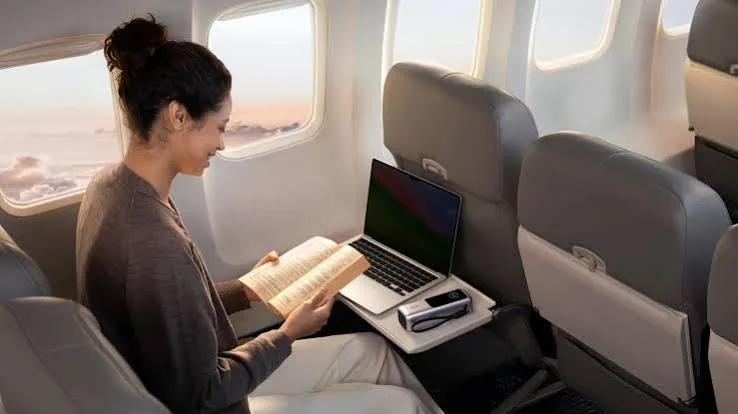
"Can you fly with a power bank?" is one of the most common travel questions we hear at City Gadgets Kenya, usually from someone standing in our shop the day before a flight. The short answer is yes, in most cases, but with rules about where you pack it, how big it is and sometimes how you use it. This guide explains the rules in plain language, shows you how to convert the mAh number on the label into watt-hours, and gives you a checklist for your next trip.
An important note first. Aviation rules are set by international bodies, national aviation authorities and each airline, and they change. Some airlines have recently added extra restrictions on using power banks in flight. What we write here is general guidance based on widely used limits. Your airline's own current policy always governs. Check it before you travel, and if you are unsure, ask the airline or the airport.
We are at New Alnoor Exhibition, Second Floor, Shop C7, Accra Road, Nairobi CBD, with same-day Nairobi delivery and next-day delivery outside Nairobi. Message us on WhatsApp if you want help choosing a travel-friendly power bank.
The short version
- Carry-on only. Power banks go in your cabin baggage, not in checked luggage. This is the most widely applied rule.
- Under or at 100 Wh: generally allowed without special approval, subject to airline limits on how many you can carry.
- Between 100 Wh and 160 Wh: usually needs airline approval, and airlines often limit you to two.
- Over 160 Wh: generally not allowed on passenger aircraft.
- Protect the terminals. Keep the power bank from short-circuiting: original packaging, a pouch or tape over exposed contacts.
- In-flight use: some airlines restrict or ban using a power bank during the flight. Check your airline.
- Label matters. A power bank with a clear Wh or mAh and voltage rating is easier to clear at security than an unlabelled one.
| Capacity (Wh) | Typical rule | Notes |
|---|---|---|
| Up to 100 Wh | Generally allowed in cabin | Airline may limit the number |
| 100 to 160 Wh | Airline approval usually needed | Often limited to two |
| Over 160 Wh | Generally not allowed | Do not try to carry |
| Unlabelled or damaged | May be refused | Do not travel with it |
Why airlines care about power banks
A power bank is a lithium-ion battery in a case. Lithium-ion cells are safe in normal use, but if they are damaged, overheated, short-circuited or poorly made, they can go into thermal runaway: a rapid, self-sustaining overheating that can cause smoke and fire. In a cabin, crew can respond to a fire and can reach the device. In a cargo hold, a fire can grow before anyone notices. That is the main reason power banks must travel in the cabin.
Airlines and regulators also care about the quality of power banks in circulation. A genuine power bank from a reputable maker has protection circuits for over-charge, over-discharge, over-current, short-circuit and temperature. A poor quality or fake unit may skip those protections. This is one reason we put so much emphasis on buying genuine products, and why this article includes a section on spotting fakes.
For a deeper look at how batteries age and fail, see our lithium-ion battery care guide.
What is a Wh and why does it matter?
Airline rules are written in watt-hours (Wh), which measure the total energy stored in a battery. Power bank labels, however, usually show mAh (milliamp-hours). These are not the same thing, and you cannot compare them directly without the voltage.
The formula is:
Wh = (mAh ÷ 1000) × voltage
For lithium-ion power bank cells, the nominal voltage is usually 3.6 V or 3.7 V. Labels on better power banks include the Wh figure, but many cheaper units show only mAh. Here is how to convert.
| Labelled mAh | At 3.7 V | Approx. Wh |
|---|---|---|
| 5,000 mAh | 5 × 3.7 | 18.5 Wh |
| 10,000 mAh | 10 × 3.7 | 37 Wh |
| 20,000 mAh | 20 × 3.7 | 74 Wh |
| 26,800 mAh | 26.8 × 3.7 | 99.2 Wh |
| 30,000 mAh | 30 × 3.7 | 111 Wh |
| 40,000 mAh | 40 × 3.7 | 148 Wh |
So a 20,000 mAh power bank is about 74 Wh and is comfortably under the 100 Wh line. A 30,000 mAh power bank is about 111 Wh and falls into the 100 to 160 Wh category that usually needs airline approval.
For more on this, read our power bank mAh vs Wh explained guide.
A worked example: the Anker Prime 26K
The Anker Prime Power Bank (26,250 mAh, 300W) in our range is a good example. Using the formula with the 3.7 V cell voltage:
26,250 mAh ÷ 1000 = 26.25 Ah 26.25 Ah × 3.7 V = about 97 Wh
That puts it just under the 100 Wh line, which is why this type of high-capacity power bank is designed to be airline-friendly. The label on the unit should show the Wh rating, and we confirm per unit. If your power bank shows a rating that places it near 100 Wh, check the exact figure printed on it, because rounding matters at the border.
This is also why you should not assume that "26K" and "30K" are close. They look close in marketing, but one can be under the line and one over it.
Do you need to show the Wh to security?
Security staff at airports usually look for a label showing the capacity. A power bank with a clearly printed Wh rating, a recognised brand name and certification marks is easy to check. A blank or scratched unit invites questions. If the label only shows mAh, be ready to convert it, and consider carrying the original box or a screenshot of the specifications from the maker.
Carry-on, checked baggage and personal items
The principle is simple: spare lithium batteries, including power banks, go in the cabin. Do not pack them in checked bags. If a gate agent asks you to check a carry-on because the overhead bins are full, remove your power banks and take them with you into the cabin.
Practical packing tips:
- Keep power banks in a pouch or compartment where they cannot be crushed.
- Keep cables separate so metal ends do not touch the terminals.
- Do not put loose power banks in a pocket with coins and keys.
- Keep the power bank accessible. If crew ask about it, you can show it quickly.
- Turn it off before packing, if it has a power button.
Using a power bank on board
This is where airline policies have been changing. Some airlines now prohibit using a power bank to charge a device during flight, or require it to be kept visible rather than in a closed bag or overhead locker. Others allow use but ask you to monitor it. Some prohibit power banks in overhead lockers completely.
Because rules differ, the safest approach is:
- Check the airline's website before you fly.
- Keep your power bank where you can see and reach it.
- If it becomes hot, swollen, smoking or smells unusual, stop using it and tell cabin crew immediately.
- Do not charge the power bank itself from the seat power during the flight unless the airline allows it.
- Follow crew instructions at all times.
Number of power banks you can carry
Rules about quantity vary. A common approach is to allow multiple power banks under the 100 Wh limit and to cap the number above 100 Wh at two, with approval. Some airlines set a lower overall limit. If you travel with several power banks for a team, check the policy first rather than discover the limit at the gate.
Choosing a travel-friendly power bank
If you fly often, the right power bank makes airports simpler. What to look for:
A clear Wh or mAh rating printed on the unit. Without it, you may have trouble at security. Prefer brands that print the specifications on the body, not only on the box.
A capacity that suits your trip, under 100 Wh. For most travellers, 10,000 to 20,000 mAh covers a phone several times over. A 20,000 mAh unit at about 74 Wh is comfortably within the usual limit. If you carry a laptop, a 100 W class power bank with around 20,000 to 26,000 mAh gives a useful charge to a laptop and still sits near or under the line. We confirm per unit.
Fast charging that matches your devices. USB-C Power Delivery is the common standard. Our USB Power Delivery explained guide shows what wattage you need.
Good safety protection. Look for over-charge, over-discharge, over-current, short-circuit and temperature protection, and for recognised safety certifications on the label.
A sensible size. A power bank you can carry comfortably is a power bank you will actually use.
Browse the accessories category and message us on WhatsApp for today's price on power banks suited to travel.
Power banks vs the battery in your devices
Phones, laptops, cameras, e-readers and earbuds also contain lithium-ion batteries. These are installed in the device and are treated differently from spare batteries. Most airlines allow devices with installed batteries in either cabin or checked baggage, though carrying them in the cabin is recommended and sometimes required for larger ones. Spare batteries and power banks must be in the cabin.
A laptop battery usually sits well under 100 Wh. Camera batteries, drone batteries and e-bike batteries are different cases, and drone and e-bike batteries are often much larger than 100 Wh. If you travel with these, read the airline rules carefully and ask in advance.
Power stations and large batteries
Portable power stations, the box-style units used for camping or backup power, are usually well above 160 Wh and are generally not permitted on passenger aircraft. A small "portable power station" with a battery of a few hundred Wh is typically over the limit. If you need power at your destination, buy or hire a unit there, or ship it using an appropriate freight service that accepts lithium batteries. Check the carrier's rules.
International travel and transit
If you travel through several airports, the strictest rule among the airlines and the countries involved applies in practice. Some countries enforce their own rules at security checkpoints. Things that help:
- Check every airline on your itinerary, not only the first.
- Keep your power bank in your hand luggage during transit.
- Be prepared for security staff to ask you to remove and show it.
- Keep documentation or a screenshot of the specifications on your phone.
What happens if your power bank is not allowed
If a power bank exceeds the limit, lacks a label or looks damaged, security staff may ask you to leave it behind. You will not be allowed to check it into the hold. Our advice: do not travel with a power bank you are unsure about. Replace it with a genuine, clearly labelled unit before you fly.
Damaged, swollen or recalled power banks
Never fly with a power bank that is swollen, dented, hot, leaking, smelly or has been dropped hard. Damaged lithium cells are the main risk. Do not throw an old power bank in a bin, because lithium batteries can start fires in waste handling. Take it to a proper electronics recycling point. If you want advice about an old power bank, message us.
Also pay attention to safety recalls. When a manufacturer announces a recall for a model, stop using it and follow the manufacturer's instructions.
How power banks are made safe
Genuine power banks include a battery management circuit that monitors cell voltage, current and temperature. They limit charging voltage to protect cells from over-charge, stop discharge before the battery is damaged, cut output on short circuit and reduce power if the battery overheats. Good makers also test their cells and cases to recognised safety standards.
Fake or very cheap power banks often skimp on this. They may use low-quality cells, omit protection circuits, or exaggerate capacity. This is why our fast charging and battery health myths guide and our Qi2 and MagSafe wireless charging guide both stress buying from trusted sources.
Example scenarios
These scenarios are illustrative, not customer records.
A business traveller flying Nairobi to Mombasa with a 20,000 mAh power bank. About 74 Wh, under the limit. Packed in the cabin bag, labelled, no problem expected. The traveller checks the airline's in-flight use policy before boarding.
A photographer with a 40,000 mAh power bank. About 148 Wh, in the 100 to 160 Wh band. The photographer needs airline approval before the trip and carries only one. A better plan may be two 20,000 mAh units.
A family with four phones and two tablets. Several smaller power banks under 100 Wh each may be easier than one big unit, and quantity limits should be checked with the airline.
A student travelling with an unbranded 30,000 mAh power bank with no label. About 111 Wh if the claim is true, which would need approval, and the label is missing. Security may refuse it. Replacing it with a clearly labelled genuine unit solves the problem.
Packing a power bank step by step
Good packing makes security quick and keeps the battery safe. Follow these steps the night before your flight.
- Inspect the power bank. Look for dents, swelling, cracks, burn marks or a strange smell. If you find any, do not fly with it.
- Read the label. Confirm the capacity and Wh rating. If only mAh is shown, convert it and write the result on a note in your bag.
- Charge it partly, not fully, if you can. Many travellers keep batteries at a moderate charge for storage, but a charged power bank is fine for travel as long as it is undamaged. Check airline guidance.
- Switch it off. If it has a button or a switch, turn it off so it cannot activate by accident.
- Cover the ports. Put it in a pouch, its original box or a small bag so nothing metal can touch the contacts.
- Separate the cables. Keep cables in another pocket so connectors do not press on the ports.
- Place it in your cabin bag. Put it where you can reach it quickly.
- Take a screenshot of the specification page for your phone.
Understanding the numbers on the label
Power bank labels are packed with numbers, and it helps to know what they mean.
- Capacity (mAh): the headline number. It is measured at the cell voltage, usually 3.6 or 3.7 V, not at the output voltage.
- Rated capacity or output capacity: often lower than the headline, because some energy is lost in conversion. For example, a 20,000 mAh power bank may deliver a smaller amount at 5 V.
- Input: the voltage and current the power bank accepts when you recharge it.
- Output: the voltage and current each port can provide, such as 5 V, 9 V, 12 V, 15 V or 20 V on USB-C Power Delivery.
- Wh: the energy rating airlines care about.
The airline limit is based on the battery's rated energy, not on how many times it can charge your phone. A power bank that charges a phone four times is not necessarily a 40 Wh unit, because phone batteries differ and conversion losses take a share.
Why real capacity is lower than the label
A 20,000 mAh power bank will not give you 20,000 mAh at 5 V to your phone. Two reasons:
- Voltage conversion. The cells run at about 3.7 V and the output is boosted to 5 V or higher, which loses energy as heat.
- Efficiency. Typical efficiency is around 60 to 90 percent depending on the design and load.
So a good 20,000 mAh power bank might deliver the equivalent of roughly 12,000 to 14,000 mAh to a phone at 5 V. This does not change the airline rule, which uses the cell rating, but it is useful to know when you plan charges.
Airport security: what to expect
At Jomo Kenyatta International Airport and most other airports, your cabin bag goes through an X-ray scanner. Power banks look like dense, rectangular objects on the scan, and staff may ask you to remove them or open the bag. Cooperate politely, show the label and answer questions plainly. If staff need to check the Wh and the label is unclear, having the specifications on your phone helps.
Rules at different airports and airlines can differ in how strictly they apply the limits, so keep a margin. Do not carry a power bank that is right on the edge of the limit if you can choose one that is comfortably below it.
Wireless and magnetic power banks
Magnetic and wireless power banks, such as those that snap onto the back of a phone, are also lithium-ion batteries and follow the same rules. They are usually smaller, often 5,000 to 10,000 mAh, and well under 100 Wh. Keep them in your cabin bag, not stuck to a phone in a checked bag. If you use a magnetic power bank on a phone in flight, check whether your airline allows in-flight use. Our Qi2 and MagSafe wireless charging guide explains these in depth.
Other things travellers often ask
Can I bring a power bank in my pocket? Yes, if it is in the cabin, but protect the ports. Many travellers prefer a pouch.
What about cables and chargers? Cables and wall chargers are fine in either cabin or checked luggage, though keeping them in the cabin helps you avoid loss.
What about e-cigarettes and vapes? These have their own rules. Check your airline.
What about a laptop with a large battery? Laptop batteries are usually under 100 Wh and are allowed in the cabin. Gaming laptops with larger batteries should be checked against the label. Our laptops category lists models, and we confirm per unit.
Myths about flying with power banks
"If it is small, it is always fine." Size is not the rule. The energy rating is. A small, dense power bank can still exceed a limit, although most small units are well under it.
"Checked bags are safer for batteries." The opposite is true. A battery fire in a hold is harder to detect and fight, which is why power banks must travel in the cabin.
"The airline will let me use it however I like." Not always. Several airlines now restrict in-flight use. Check before you fly.
"Any label is enough." A label that is missing, scratched, handwritten or inconsistent may not satisfy security. A printed, readable label from a recognised maker is best.
"Airline rules are the same everywhere." The broad framework is similar, but details such as quantity limits, approval processes and in-flight use policies differ by airline and country.
"A bigger power bank is always better value." Only if you can actually fly with it. A 40,000 mAh power bank that needs approval and sits over the common limit can be a bad choice for frequent flyers compared with two compact 20,000 mAh units.
Planning charging for a long trip
For a long trip, think about your total energy needs rather than the biggest power bank. List your devices: phone, earbuds, smartwatch, tablet and perhaps a laptop. Estimate how many charges you need between wall outlets. A phone battery is typically 12 to 20 Wh, so a 74 Wh power bank, after losses, can give several phone charges. A laptop battery is often 40 to 70 Wh, so one laptop charge consumes most of a power bank.
Hotels and airports often have outlets. A compact GaN wall charger can charge several devices fast when mains is available, and a power bank covers the gaps. Using both together is usually lighter and simpler than carrying a very large power bank.
A final word on flying with power banks
The rules sound complicated, but the habit is simple: keep it in the cabin, know the Wh, keep it undamaged and labelled, and check your airline's current policy on use and quantity. If you do those four things, flying with a power bank is routine for almost everyone. If you are ever unsure at the airport, ask the airline staff politely and follow their instruction. A small delay at the gate is far better than a safety problem in the air.
Travelling with kids, teams and equipment
Families and teams often carry many power banks at once. A few practical suggestions help everyone move through security quickly. Give each adult responsibility for their own power banks rather than pooling them in one bag, so the quantity in any single bag stays modest. Keep a list of the capacities in your phone notes. Teach children not to play with power banks, since a dropped or crushed unit is a safety risk. For production crews or event teams carrying many batteries, contact the airline in advance and ask about their policy on quantity and approvals. It is much easier to arrange this before the day of travel than at the check-in desk.
If you travel with a camera or drone, remember that spare camera and drone batteries follow the same cabin rule and the same Wh logic. Label each battery with its Wh rating, keep them in individual protective cases and carry them in your cabin bag.
How to spot a fake power bank
Fake power banks are a safety risk and a travel risk. Here are ten checks.
- Check the capacity claim. A "30,000 mAh" power bank that is small and light for its stated capacity is suspicious. Real cells have weight.
- Compare weight to a genuine unit. A genuine 20,000 mAh power bank has noticeable heft. A very light unit is a red flag.
- Read the label. A genuine label shows brand, model, capacity, input and output ratings, Wh, certification marks and manufacturer details. Missing or blurry text is a warning.
- Check spelling and print quality. Misspellings, uneven fonts and cheap labels are common on fakes.
- Test the actual capacity. If a power bank claims many charges but delivers far fewer, the claimed capacity is likely inflated.
- Test charging speed. A unit that claims fast charging but charges slowly, or gets very hot, deserves suspicion.
- Check the ports and build. Loose ports, rough edges and gaps in the casing suggest poor manufacturing.
- Check the brand's authentication method. Some brands have serial numbers or verification pages. Verify them.
- Look at the packaging. Genuine packaging is consistent and well made. Poor print and mismatched details are red flags.
- Check the seller. Unusually low prices, no shop address and no receipt are warning signs.
If you are unsure, bring the power bank to our shop and we will help you check it. We will not pretend a fake is genuine.
Why buy your power bank from City Gadgets Kenya
- Genuine products, checked before they reach you.
- Clear specifications, so you can work out the Wh before you fly.
- A real shop at New Alnoor Exhibition, Second Floor, Shop C7, Accra Road, Nairobi CBD.
- Same-day delivery in Nairobi and next-day delivery outside Nairobi.
- M-Pesa payment and clear receipts.
- Honest advice, including telling you when a smaller power bank is the better travel choice.
- Support after the sale, with our repair service for related devices.
- WhatsApp help on +254745575931.
Browse our accessories category for power banks, cables and chargers.
Pre-flight checklist for your power bank
- It is in my carry-on, not checked baggage.
- I converted the mAh to Wh and it is within the airline's limit.
- The label is clear and readable.
- It is not damaged, swollen or hot.
- The terminals are protected, with the unit in a pouch or its box.
- I checked my airline's policy on in-flight use and quantity.
- I have a screenshot of the specifications on my phone.
- I know where my power bank is during the flight.
Frequently asked questions
Can you fly with a power bank in Kenya? Yes, in general, in your carry-on, within the airline's Wh and quantity limits. Always check your airline's current policy.
Can I put a power bank in checked luggage? No. Spare lithium batteries and power banks should travel in the cabin.
What is the maximum power bank size for a flight? The widely used limit is 100 Wh without approval, up to 160 Wh with airline approval, and above 160 Wh generally not allowed.
How do I convert mAh to Wh? Divide mAh by 1000 and multiply by the voltage, usually 3.7 V. A 20,000 mAh power bank is about 74 Wh.
Is a 20,000 mAh power bank allowed on a plane? At about 74 Wh it is normally within the usual limit, subject to your airline's rules.
Is a 30,000 mAh power bank allowed? At about 111 Wh it is in the 100 to 160 Wh band, which usually requires airline approval.
Can I use my power bank during the flight? Some airlines restrict this. Check before you fly.
Do I need to take it out of my bag at security? Often yes. Be ready to show it.
What if my power bank has no label? It may be refused. Replace it with a labelled genuine unit.
Can I carry a power station? Large power stations are usually over 160 Wh and are generally not allowed on passenger flights.
What do I do if a power bank gets hot on a plane? Stop using it and tell the cabin crew immediately.
Where can I buy a genuine travel power bank in Nairobi? At City Gadgets Kenya, Shop C7, Second Floor, New Alnoor Exhibition, Accra Road.
Ready for your next trip?
Tell us where you are flying, what you need to charge and how long you will be away, and we will suggest a power bank that fits the rules. Message us on WhatsApp or visit the shop.
Related reading: Power bank mAh vs Wh explained · USB Power Delivery explained · Lithium-ion battery care guide · Car charger safety explained
Aviation rules change. This article is general guidance, not legal or regulatory advice. Always follow your airline's current policy and the instructions of airport and cabin staff.








