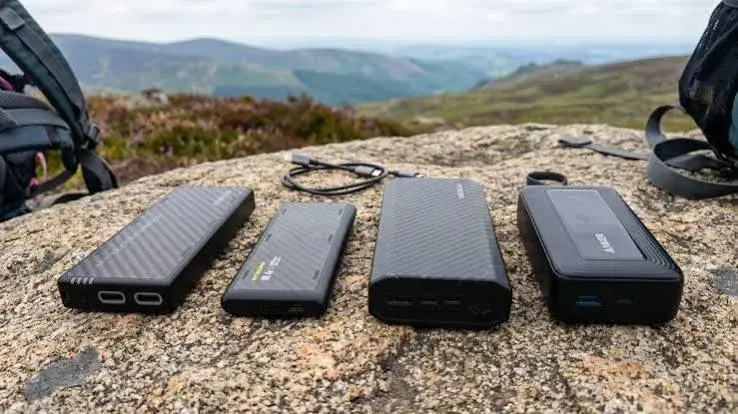
Power cuts, long matatu rides, field work, flights, conferences and weekends away: a power bank has become as essential as a phone charger. But the shelves and online shops are full of power banks with huge numbers printed on them, 30,000 mAh, 50,000 mAh, "super fast", and prices that seem too good to be true. Many of those numbers are exaggerated, and some cheap units are unsafe. This guide to the best power bank in Kenya explains capacity and watts in plain language, compares the genuine Anker power banks we stock, and shows you how to avoid fakes.
We are City Gadgets Kenya, at New Alnoor Exhibition, Second Floor, Shop C7, Accra Road, Nairobi CBD, with same-day delivery in Nairobi and next-day delivery outside Nairobi. Specifications come from Anker's published information and retailer listings, and we say "we confirm per unit" where details vary. Prices change, so message us on WhatsApp for today's price.
The short version
- Best for laptops and heavy users: Anker Prime 26K 300W, with 26,250 mAh and up to 300W across ports, per Anker.
- Best high-capacity all-rounder: Anker 25K 165W, with 25,000 mAh, 165W maximum output and built-in retractable cables, per Anker.
- Best for phones, all-day: Anker Zolo 20K 22.5W, with 20,000 mAh and a built-in USB-C cable.
- Best compact: Anker Zolo 10K 30W, with 10,000 mAh and a built-in cable.
- Best for iPhone magnetic charging: Anker MagGo 10,000 mAh magnetic wireless power bank, for compatible phones.
- Best value large: Anker 20K 30W, with 20,000 mAh and 30W output.
| Model | Capacity | Output | Best for |
|---|---|---|---|
| Anker Prime 26K | 26,250 mAh | Up to 300W total | Laptops, tablets, phones together |
| Anker 25K 165W | 25,000 mAh | Up to 165W | Laptops and phones, built-in cables |
| Anker Zolo 20K | 20,000 mAh | Up to 22.5W | Phones, long days |
| Anker 20K 30W | 20,000 mAh | 30W | Phones, tablets |
| Anker Zolo 10K | 10,000 mAh | 30W | Pocket carry, phones |
| Anker MagGo 10K | 10,000 mAh | Magnetic wireless (Slim version Qi2 up to 15W, per a retail listing) | iPhone and compatible phones |
Figures are per Anker and retailer listings, and we confirm the exact model and version per unit.
mAh, Wh and watts: what the numbers mean
Capacity: mAh
mAh (milliamp-hours) describes how much charge a battery stores. A phone battery is typically in the region of 3,000 to 5,000 mAh. A 10,000 mAh power bank, in theory, holds enough for two full phone charges, but in practice you get less, because of losses.
Why you never get the full mAh
A power bank's battery runs at about 3.7 volts, but your phone charges at 5 volts or higher through the USB port. Converting voltage wastes some energy as heat, and so does the cable and the phone's own charging. As a rough guide, you often get somewhere around two-thirds of the printed capacity in real use, though it varies by power bank, phone and charging speed. So a 10,000 mAh bank gives roughly 1.3 charges of a 5,000 mAh phone, not 2. These are estimates, not promises. Anker's own lab figures for the Zolo 20K are about 3.7 charges for an iPhone 16 and about 4.2 for a Samsung S24, per Anker.
Energy: Wh
Wh (watt-hours) is a better measure, because it accounts for voltage. You can estimate it from mAh by multiplying by 3.7 volts and dividing by 1,000.
| Printed capacity | Approximate energy |
|---|---|
| 10,000 mAh | 37 Wh |
| 20,000 mAh | 74 Wh |
| 25,000 mAh | 92.5 Wh |
| 26,250 mAh | about 97 Wh |
These are our calculations from the printed capacity and a 3.7 V cell, not Anker's stated figures. Airlines care about Wh, which we explain below.
Output: watts
Watts describe how fast the power bank can deliver energy. A phone may charge at 20 to 30 W, a tablet at 30 W or more, and a laptop commonly needs 45 to 100 W. A power bank rated 22.5 W can charge a phone quickly but cannot power a laptop. A power bank with 140 W per port, like the Anker Prime 26K per Anker, can charge a laptop at high speed. Always check both the capacity and the output.
Input: how fast the power bank recharges
A large power bank takes a long time to recharge from a slow charger. Some, like the Anker Prime 26K, can recharge at up to 250 W using both USB-C ports together, per Anker, which needs suitable chargers and cables. Check the recharge speed if you will recharge it often or overnight.
Choosing capacity by use
Light phone use (10,000 mAh). A 10,000 mAh power bank gives about one to one-and-a-half phone charges. It is pocket sized and light. Good for a day out.
Heavy phone use or two people (20,000 mAh). A 20,000 mAh power bank gives roughly two to three phone charges in practice. It is bulkier but lasts a couple of days.
Laptops and tablets (25,000 mAh and above, with high output). A laptop needs both capacity and watts. A 25,000 mAh bank holds about 92.5 Wh, and a typical thin laptop battery is in the range of 40 to 70 Wh, so you may get one charge or less, depending on the laptop. The output must also match what the laptop needs.
Power cuts at home. For phones and a router, capacity is useful. Note that a power bank cannot run most routers directly unless it provides the right voltage. A UPS is the right tool for that, which our UPS guides cover.
Travel and flights. Keep to airline limits, covered below.
Anker Prime 26K 300W: the powerhouse
The Anker Prime 26K is the most capable power bank in our range. Per Anker, it has 26,250 mAh, up to 300W total output across ports, two USB-C ports and one USB-A, up to 140W per USB-C port with a 5A cable, and can recharge at up to 250W using both USB-C ports together. It has a smart display and works with the Anker app, and supports two-way charging and is airline-safe, per Anker.
Good for:
- Charging a laptop at high speed on the move.
- Powering a laptop, tablet and phone at once.
- Photographers, engineers and consultants who travel.
- Anyone who wants one power bank for everything.
Things to know:
- It is heavier and larger than phone-sized banks.
- To get its top speeds you need the right cables, such as a 5A-rated USB-C cable. Our USB-C cable guide and Anker cables in the accessories category help.
- If your devices charge at lower speeds, you will not use the full 300W.
- At about 97 Wh by our calculation, check the label and your airline's rules.
Anker 25K 165W: laptops with built-in cables
The Anker 25K 165W (model A1695, per Anker's listing) offers 25,000 mAh, up to 165W maximum output, and built-in and retractable cables, so you carry fewer loose cables.
Good for:
- Travellers who want cables built in.
- Charging a laptop and a phone together.
- Heavy users who want strong output at a lower weight than the biggest banks.
Things to know:
- Built-in cables are convenient, but if one fails, you rely on the other ports.
- Check the exact version and cable types per unit.
Anker Zolo 20K 22.5W: the phone marathon runner
The Anker Zolo 20K (model A110E, per retailer listings) offers 20,000 mAh, up to 22.5W from a single USB-C port or the built-in cable, a built-in USB-C cable about 7 inches long (tested by Anker for 10,000 bends), plus one USB-C and one USB-A port. It supports pass-through, so you can charge a device while the power bank itself recharges. Anker's lab figures show about 3.7 charges for an iPhone 16 and about 4.2 for a Samsung S24.
Good for:
- Phone users who want several charges.
- Students and commuters.
- People who forget cables, since one is built in.
Things to know:
- At 22.5 W, it is for phones and some tablets, not laptops.
- Anker's lab figures are not guarantees.
Anker 20K 30W: a larger, faster-charging option
The Anker 20K 30W gives 20,000 mAh and 30W output. 30 W suits many phones and tablets, and some small laptops depending on their needs. Ask us to confirm the ports and cables on the version in stock.
Anker Zolo 10K 30W: pocket power
The Anker Zolo 10K offers 10,000 mAh and 30W output, with a built-in USB-C cable about 5.4 inches long, per Anker's listing. It is slim enough for a pocket or a small bag.
Good for:
- Daily carry.
- Phones and earbuds.
- Minimalists who want a light, cable-included design.
Things to know:
- It gives about one to one-and-a-half phone charges.
- A short cable is handy but limits placement while charging.
Anker MagGo 10,000 mAh: magnetic wireless charging
The Anker MagGo power bank clings magnetically to compatible phones, and charges them wirelessly without a cable. A slim version, the MagGo Slim 10K, is Qi2-certified for up to 15W charging, per a retail listing.
Good for:
- iPhone and other compatible magnetic-charging phones.
- Charging while holding or using the phone.
- People who dislike cables.
Things to know:
- It works with phones that support magnetic wireless charging. A case that blocks the magnets can get in the way.
- Wireless charging is slower and warmer than cable charging.
- Confirm the version and compatibility with us before you buy.
Which power bank is right for you?
I only want to charge my phone once or twice a day. Anker Zolo 10K 30W.
I am out all day and use my phone heavily. Anker Zolo 20K 22.5W or Anker 20K 30W.
I use an iPhone and hate cables. Anker MagGo.
I need to charge a laptop. Anker Prime 26K 300W or Anker 25K 165W, depending on the laptop's wattage.
I travel often by plane. Anker Prime 26K, which is airline-safe per Anker, or a 20,000 mAh model for easier limits. Check your airline.
I want the lightest option. Anker Zolo 10K.
I just want a reliable backup for power cuts. A 20,000 mAh bank for phones.
Can a power bank charge my laptop?
Sometimes. Three conditions must be met:
- The laptop must charge over USB-C at a wattage the bank can supply. Many thin laptops charge at 45 to 100 W. Older laptops with barrel-shaped chargers cannot use a power bank.
- The power bank must output enough watts on a single port. A 22.5 W bank cannot charge a laptop that wants 65 W. It may trickle or not charge at all.
- The cable must be rated for the power. A cheap cable may limit charging. For 100 W and above you need a suitably rated cable.
The Anker Prime 26K and Anker 25K 165W are the models in our range aimed at laptop charging. Tell us your laptop model on WhatsApp and we will check.
Flying with a power bank
Airlines treat power banks as spare lithium batteries, and the general rules are:
- They go in carry-on baggage, not checked luggage.
- The limit commonly applies to watt-hours: up to 100 Wh is usually allowed, and 100 to 160 Wh may need airline approval.
- Airlines may limit the number of power banks per passenger.
- Some airlines restrict using a power bank during flight.
Because rules differ and change, check your airline's current policy before you travel. Look for the Wh figure printed on the power bank. By our calculation, a 26,250 mAh bank is close to 97 Wh, so read the label, and a 20,000 mAh bank is well under the limit. Anker describes the Prime 26K as airline-safe, but you should still confirm with your airline.
Charging speed: cables and chargers matter
A power bank is only part of the story. To get its speed, you need:
- A cable rated for the power. Cheap cables limit speed or overheat.
- A suitable charger to recharge the bank. A slow charger can take many hours to refill a large bank.
- A device that supports fast charging. Some phones charge at 20 W, some at 45 W or more.
- The right port. Some banks share power between ports, so the output drops when you plug in several devices.
Anker cables and chargers are in our accessories category. We recommend a charger that suits the bank's input.
Safety: what to know about lithium batteries
Power banks hold a lot of energy in a small package. Genuine units include protection against overcharge, overheating and short circuits. Fakes often skip these, which is why cheap unbranded banks can swell, overheat or catch fire.
- Buy genuine from a seller with a shop and receipt.
- Do not use a swollen, damaged or very hot power bank. Stop using it and contact the seller.
- Do not charge it under a pillow or on a bed. Keep it in an open, ventilated place.
- Do not leave it in a hot car or in direct sun.
- Do not drop it or crush it in a bag.
- Do not charge it unattended for long periods.
- Use good-quality cables and chargers.
- Dispose of old batteries responsibly, not in the household bin.
Real-world scenarios
These are illustrative scenarios, not customer records.
The student with a long commute. They use their phone for maps, music and messages and leave home at 6 am. A 10,000 mAh bank gets them through the day, and a 20,000 mAh bank gets them through a couple of days.
The consultant who travels. They work on a thin laptop and a phone. A high-output bank such as the Prime 26K or the 25K 165W gives them a safe buffer in airports and on site.
The shopkeeper during outages. They keep a 20,000 mAh bank to keep a phone and a payment device running when the power cuts out.
The photographer on location. They charge a camera battery charger, a phone and a tablet. A larger bank with multiple ports saves them looking for sockets.
Power bank or UPS?
They solve different problems. A power bank charges small devices through USB. A UPS keeps mains-powered equipment, such as a router, monitor or computer, running during an outage. If you want your internet to stay up during power cuts, you need a UPS or a battery solution made for routers. Our UPS guides explain how to choose, including UPS VA vs watts and how long a UPS will run. A power bank is a complement, not a replacement.
How many charges will you really get? A worked example
Let us work through an illustrative example so the numbers make sense. These are our estimates, not Anker's figures.
Suppose your phone has a 5,000 mAh battery, and you use a 20,000 mAh power bank. In theory, you could charge the phone four times. But the power bank's battery runs at about 3.7 V and your phone charges through the USB port at a higher voltage, with losses along the way. If you assume that around two-thirds of the capacity reaches your phone, the bank delivers the equivalent of about 13,000 mAh, which is roughly 2.6 phone charges. That is a typical, honest expectation, and Anker's lab figures for the Zolo 20K, about 3.7 charges for an iPhone 16 and 4.2 for a Samsung S24, apply to phones with smaller batteries than 5,000 mAh and to Anker's test conditions.
For a laptop with a 50 Wh battery, a 25,000 mAh bank holds about 92.5 Wh at the cell level, and with losses you might get 55 to 60 Wh of usable energy, which is a little over one full laptop charge. That is why a laptop user should think in watt-hours, not only mAh, and why a high-output bank with a large capacity is the right tool.
The rule of thumb: divide the printed capacity by about 1.5 for a realistic figure, then divide by your device's battery size. Treat it as a planning guide.
Charging more than one device
Many power banks share their total output across ports. If a bank is rated 30 W and you plug in two phones, each may charge more slowly. The Anker Prime 26K is rated at 300 W across ports, per Anker, with up to 140 W on a single USB-C port, so it can divide power among a laptop and phones. When you plug in several devices, the bank decides how to share, and the display on models like the Prime shows what is happening. If speed matters, charge the most important device first, or use the highest-power port for your laptop.
Power banks for specific uses
Camping and outdoor events. A large-capacity bank keeps phones and lights going. Keep it dry and out of the sun.
Business trips and conferences. A laptop-capable bank takes the stress out of finding a socket in a hall.
Photography and videography. Charging camera batteries, drones, phones and tablets in the field is a perfect job for a large bank with several ports.
Students. A compact 10,000 mAh bank does the job for lectures and hostels.
Boda boda and delivery riders. A phone running navigation all day drains fast. A compact bank in a bag or pocket, kept out of heat and rain, is a practical tool. Use a secure mount and cables that will not snag.
Market and shop owners. A phone used for M-Pesa and customer messages is a business tool. A reliable bank is cheap insurance against lost sales when the power fails.
Reading a power bank's label and listing
Learn to read the specification label, because it tells you more than the box front.
Input and output ratings. Look for the voltage and current combinations, such as 5V, 9V, 12V, 15V or 20V at various amps. Higher voltage options show support for fast charging protocols.
Capacity statement. A genuine label often shows both mAh and Wh. If it shows only an inflated mAh, be wary.
Model number and certification marks. They should match the maker's website and look properly printed.
Port count and types. USB-C is the modern standard. A bank with only old micro-USB ports is outdated.
Features. Pass-through, display, app, retractable cables and wireless charging are conveniences, and each adds complexity. Ask what you will actually use.
Warranty. A genuine seller states how long it lasts and how to claim.
If the label and the listing disagree, ask the seller before paying.
After-sales: what to do if something goes wrong
If your power bank charges slowly, stops charging, swells, overheats or shows an error, stop using it and bring it to us at Shop C7, New Alnoor Exhibition. Bring your receipt and the cables you used. We will check the unit, explain the warranty that applies and advise on the next step. Never open a power bank yourself, since the cells can be dangerous.
Power banks and the environment
Lithium batteries contain materials that should not end up in ordinary rubbish. When a power bank no longer holds a charge, do not throw it in the bin or burn it. Take it to a proper e-waste collection point, or bring it to us and ask for advice. Buying one good power bank and caring for it is greener than replacing cheap ones every few months.
Care, battery life and how long it will last
A power bank's battery ages with each charge cycle. After a few hundred cycles, it holds less than when new. To help it last:
- Do not run it flat all the time. Partial charges are gentler than deep discharges.
- Store it partly charged if you will not use it for weeks, and top it up every few months.
- Keep it cool. Heat is the enemy of lithium batteries.
- Use quality cables and avoid bending connectors.
- Keep ports clean. Lint in a USB-C port can stop charging.
- Do not let it get wet.
- Check it periodically for swelling, odd smells or unusual heat.
Common myths about power banks
"Bigger mAh always means better." A huge number printed on a cheap unit is often exaggerated. Output, build quality and genuine cells matter.
"Any power bank can charge a laptop." Only those with enough watts and the right ports.
"Fast charging damages the phone." Phones control how much power they accept. A power bank offers a maximum, and the phone takes what it can safely use.
"You can leave a power bank charging overnight with no risk." Genuine units have protections, but it is still sensible to charge in an open, ventilated place.
"All 20,000 mAh banks are the same." They differ in output, cells, protections, features and warranty.
"The percentage display is exact." It is an estimate.
Common mistakes when buying a power bank
- Buying on mAh alone and ignoring watts.
- Buying an unbranded unit with an inflated claim.
- Expecting a phone-sized bank to charge a laptop.
- Using a weak cable and wondering why charging is slow.
- Forgetting airline rules.
- Leaving the power bank in a hot car.
- Ignoring a swollen unit.
- Skipping the receipt and warranty.
Questions to ask any seller before you pay
- Is this a genuine Anker product, and is the box sealed?
- What is the exact model and capacity?
- What is the maximum output, and per port?
- Which cables and chargers do I need to get full speed?
- Is it suitable for my laptop or phone?
- Is it allowed on flights, and what is the Wh rating?
- What warranty applies, and who services it?
- Can you show me how the display and ports work?
How to spot a fake Anker power bank
Power banks are among the most counterfeited electronics, and fakes are risky because they handle stored energy. Use these ten checks together.
- Check the packaging. Genuine boxes have sharp printing, accurate model names and clean seals. Misspellings, blurry logos and re-taped seals are red flags.
- Check the model and capacity. The model number should match the maker's website, and the printed capacity should be realistic for the size. A very small, light unit claiming huge capacity is suspect.
- Check the weight. Real cells have weight. A 20,000 mAh unit that feels like a 5,000 mAh one is a warning.
- Check the print quality on logos, regulatory marks and the specification label.
- Check the ports and build. Ports should be clean, aligned and firm, with no rough edges.
- Check the output label. Claims such as "65 W" on a tiny, cheap bank are suspicious. Check against the model's published specification.
- Test charging. Plug in your phone and see whether it charges at a sensible speed. Warmth is normal. Excessive heat is not.
- Check the app and display features on models that have them, such as the Prime 26K's smart display and app connection.
- Check the seller and warranty. A genuine seller has a shop address, gives a receipt and states the warranty period.
- Check the price. A price far below normal for a branded power bank is a red flag.
If you are unsure, bring the power bank to New Alnoor Exhibition, Second Floor, Shop C7, Accra Road, and we will help you check it.
Why buy your power bank from City Gadgets Kenya
- Genuine Anker products, checked before they reach you.
- A real shop at New Alnoor Exhibition, Second Floor, Shop C7, Accra Road, Nairobi CBD, opening from 9:00 AM.
- Same-day delivery in Nairobi and next-day delivery outside Nairobi.
- M-Pesa payment and clear receipts.
- Honest advice, including telling you when a smaller bank is enough.
- Compatibility checks. Tell us your phone or laptop and we will confirm what works.
- Cables, chargers and hubs in our accessories category.
- Support and repairs through our repair service.
- Trade-ins through our sell page.
- WhatsApp help on +254745575931.
Your power bank checklist
- I know what I need to charge: phone, tablet or laptop.
- I chose capacity (mAh and Wh) and output (watts) to match.
- I have a suitable cable for the speed I want.
- I checked airline rules if I will fly.
- I checked the box, label and weight for signs of a fake.
- I know how to store and charge it safely.
- I have a receipt and know the warranty terms.
Frequently asked questions
What is the best power bank in Kenya? It depends on the use: the Anker Prime 26K for laptops, the Zolo 20K for phone marathons, the Zolo 10K for pocket carry and the MagGo for magnetic charging.
How many times will a 10,000 mAh power bank charge my phone? Roughly one to one-and-a-half times in practice, depending on the phone.
Can a power bank charge a laptop? Yes, if it outputs enough watts and the laptop charges over USB-C. The Prime 26K and 25K 165W are aimed at this.
Can I take a power bank on a plane? Usually in carry-on, within Wh limits. Check your airline.
Why is my power bank charging slowly? Weak cable, low-wattage port, a phone that limits speed, or a worn or fake unit.
Is wireless charging worth it? It is convenient, but slower and warmer than cable charging.
How long does a power bank last? Several years with sensible use, though capacity declines over cycles.
Can I charge while it recharges? Some models support pass-through, such as the Zolo 20K, per Anker. We confirm per unit.
Can I pay by M-Pesa? Yes.
How do I know it is genuine? Use the ten checks above.
Where can I buy a power bank in Nairobi? At City Gadgets Kenya, Shop C7, Second Floor, New Alnoor Exhibition, Accra Road.
Ready to choose?
Message us on WhatsApp with your devices and how you use them, and we will recommend the right power bank.
Related reading: Best USB-C hub in Kenya · Home office setup guide · Power bank capacity guide · Best USB-C cable in Kenya